

Minnesota Solar Performance: Why Your Panels Produce More Than You Think in Winter

Every fall, the same question lands in our inbox. From homeowners in the Twin Cities and business owners in greater Minnesota alike: does solar actually hold up through winter here?
It is a fair concern. Minnesota winters are real. Sub-zero temperatures, heavy snow events, and sunsets before 5 p.m. make it hard to picture a rooftop array carrying its weight through February.
Winter is the most challenging season for solar production, and a well-designed system accounts for that from day one.
Key Takeaways
- Cold temperatures improve panel efficiency. Solar cells convert sunlight more effectively below their rated temperature than above it.
- Snow is a temporary factor. Angled, glass-surfaced panels shed it quickly and partial coverage still allows production.
- Minnesota's annual solar resource is stronger than most people assume, comparable to parts of Texas and Florida.
- Systems are sized and modeled for annual output. Net metering credits from strong months offset winter dips.
- A 32 kW Tesla Solar Roof in Lanesboro, MN generated over 45,000 kWh annually across 2024 and 2025, running at more than 160% energy offset through real Minnesota winters.
- Every kilowatt-hour produced in winter is one you are not buying at a rising utility rate. For commercial operations, those savings compound on top of a federal tax credit that rewards acting now.
Cold Weather Is an Advantage, Not a Liability
Solar panels generate electricity from sunlight, not heat. The photovoltaic cells inside every panel are semiconductors, and like most semiconductors, they work more efficiently when they run cool.
Manufacturers rate panels at 25 degrees C (77 degrees F) under standard test conditions. According to the U.S. Department of Energy, temperatures above 77 degrees F cause decreases in voltage output, meaning cold operating conditions actively improve how efficiently panels convert available sunlight. Minnesota's cold, clear winter days keep panels well below that threshold for months at a time.
The practical takeaway for homeowners and facility managers alike:
- Bright, cold winter days can push panel output 5 to 10% above nameplate ratings
- The same temperatures that drive up heating bills also make your panels run better
- A well-designed system models for this and captures the benefit year after year
The cold is not working against your system. In this specific and measurable way, it is working for it.
Snow Does Not Shut a System Down
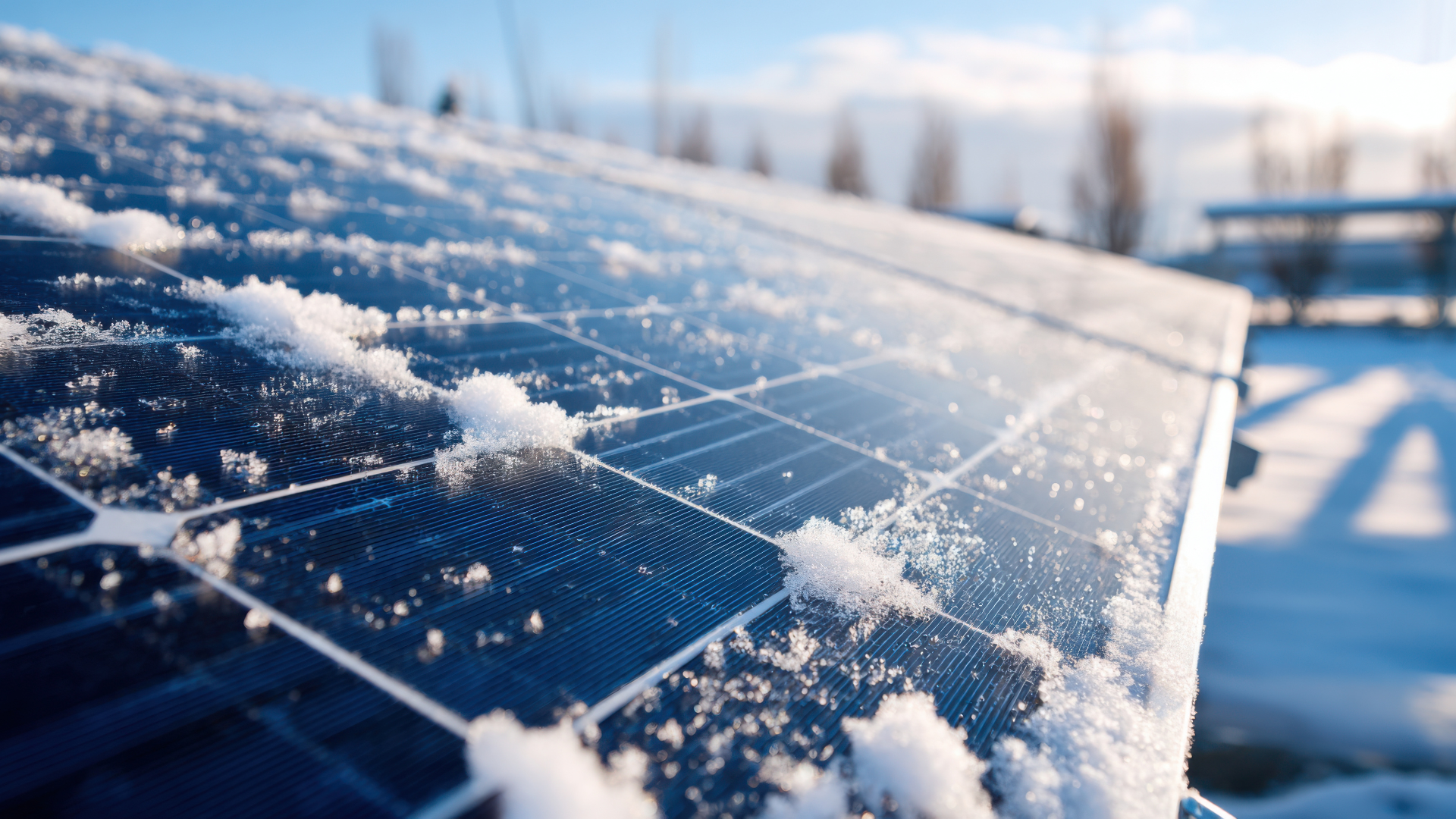
A heavy overnight snowfall will temporarily reduce output if panels are fully covered. That is real. What is also real is how quickly modern systems recover. The U.S. Department of Energy notes that even a light dusting has little impact because wind can blow it off and light can forward-scatter through a sparse coating to still reach the panel. When snow does accumulate and melt, it actually leaves panels cleaner than before, washing away any surface debris in the process.
Panels are installed at an angle with smooth tempered glass surfaces. Snow slides off on its own. Several factors accelerate that:
- Dark panel surfaces absorb sunlight and generate heat, speeding up melt from below
- Panels shed snow faster than surrounding shingles or roofing materials
- Partial exposure still allows meaningful energy generation throughout the day
- Fresh snow on the ground reflects additional light up onto the array, a phenomenon called the albedo effect, which can produce strong output numbers on clear days right after a storm
You do not need to climb on your roof. You do not need to schedule maintenance after every snowfall. In most cases, the system manages itself. Real-time monitoring lets you track production from your phone or building management system, and most issues can be diagnosed remotely.
Minnesota's Solar Resource Is Stronger Than You Think
Minnesota is not Arizona. But the assumption that it is a poor solar state is not supported by the data. Solar insolation figures from NREL, referenced in Minnesota Power's solar consumer resources, put Minnesota's annual solar resource on par with parts of Texas and Florida. Long summer days, strong spring and fall production, and cold-weather efficiency gains more than compensate for shorter winter days.
Net metering is the financial structure that makes seasonal variation manageable. When a system produces more than a home or facility uses, the excess flows back to the grid as credits. Those credits offset consumption during lower-production months. How that plays out across a year:
- Spring and fall are the strongest months for net grid performance on a well-sized system
- Summer generates peak raw production but high cooling loads often reduce net exports
- Winter is the trough, and annual system design accounts for it before installation ever begins
The electricity bill, whether for a residence or a commercial facility, reflects a full year of Minnesota sun. Not its worst month. For more on how solar pairs with rate structures to maximize annual value, see How Time-of-Use Savings Make Solar Even Smarter.
What Real Minnesota Systems Actually Produce
The strongest argument against winter hesitation is not theory. It is data from systems operating in the ground right now.
We designed and installed a 32 kW Tesla Solar Roof on Joe Deden and Mary Bell's home in Lanesboro, Minnesota. The home is all-electric with no natural gas and no supplemental heat source. It runs in-floor heating and cooling through an Arctic air-to-water heat pump rated to operate at -20 degrees F and charges a Tesla Model 3 with over 155,000 miles on it. The system includes a Tesla Powerwall for battery backup.
Two years of verified production:
- 2024: 45,552 kWh generated, 175% energy offset, 29,843 kWh exported back to the grid
- 2025: 45,972 kWh generated, 164% energy offset, 29,551 kWh exported back to the grid
That production happened through real Minnesota winters. The roof was intentionally designed at a 40-degree pitch to shed snow efficiently and capture the sun at its lower winter angle. System design is the variable that separates installations that perform from ones that disappoint.
On the commercial side, we have delivered high-performance systems for clients including Fulton Brewing in Minneapolis, where a 310 kW system was installed on a tight timeline through Minnesota winter conditions and met a year-end deadline. Scale is different between a residence and a commercial facility, but the underlying performance physics are the same.
For a full breakdown of three years of data from the Lanesboro project, see The Real Numbers Behind a Solar-Powered Life.
Built to Handle What Minnesota Throws at It
Panels installed in Minnesota are engineered for the conditions. This is not a matter of hoping the equipment holds up. It is a specification requirement built into every installation:
- Snow load ratings exceeding 50 pounds per square foot, well above typical Minnesota accumulation
- Sustained high wind and ice accumulation resistance
- Prolonged sub-zero temperature operation
- Repeated freeze-thaw cycling without performance degradation
Greenway designs every installation to meet or exceed local structural and wind load requirements specific to your property. No two roofs are the same, and system design reflects that.
The Rate Environment Makes Winter Production More Valuable Right Now
Xcel Energy, Minnesota's largest electric utility, proposed a 9.6% rate increase for 2025 and an additional 3.6% for 2026. An interim 5.2% increase, adding approximately $5.39 per month to a typical residential bill, took effect January 1, 2025. Analysis from the Citizens Utility Board projects that Minnesota electric rates could climb considerably further over the next decade.
Every kilowatt-hour a solar system generates in January is one you are not buying at an escalating retail rate. That is true for homeowners and it is true for businesses.
For commercial property owners and operators, there is an additional layer to consider. The federal Investment Tax Credit delivers a 30% base credit on qualifying commercial solar projects, with bonus adders that can push the total to 40 to 50% depending on project specifics. Projects that do not begin construction by July 4, 2026 risk reduced credits or ineligibility under current law. A system that performs through Minnesota winters and pays back through reduced utility costs over decades starts that clock the moment construction begins. Consult your tax advisor. Based on current IRS guidance under Sections 48/48E.
For a deeper look at how solar ownership holds its value as rates shift over time, see What Happens to Your Solar Investment When Utility Rates Change.
FAQs
Do solar panels produce electricity on cloudy winter days?
Yes. Panels generate power from all available daylight, not just direct sun. Output is lower on overcast days, but production does not stop. Minnesota winters also include a reliable stretch of bright, clear days between weather systems, and those tend to be the strongest production days of the cold season.
Should I remove snow from my panels or my building's array after a storm?
In most cases, no. Panels shed snow naturally through their glass surface and installation angle. Attempting removal risks damaging the equipment and the roof. If you have concerns after an unusually heavy accumulation, contact your installer rather than attempting access yourself.
Does lower winter production affect the financial case for going solar?
No. Financial projections model annual production, which already accounts for seasonal variation. What does affect the case is the rate environment: as utility rates climb, the value of every kilowatt-hour your system generates improves year over year, including in winter.
How does battery storage change the picture in winter?
A paired battery system stores solar generation for use after dark and provides backup power during outages, which are most common in winter. The Tesla Powerwall 3 is rated to operate down to -4 degrees F. The Forever Home in Lanesboro ran through five backup events across 2024 and 2025 without a generator. For businesses, battery storage also creates opportunities to reduce peak demand exposure during winter operating hours.
Is now a good time to move forward on a commercial solar project in Minnesota?
For commercial operators, the timing is meaningful. The federal ITC deadline of July 4, 2026 is approaching, and beginning construction before that date is what locks in the full credit. A winter-resilient system that produces year-round is one of the better long-term energy investments a Minnesota business can make. Consult your tax advisor. Based on current IRS guidance under Sections 48/48E.
If winter has been part of the hesitation, the engineering and the numbers point in the same direction. We work with homeowners and businesses across Minnesota and the Midwest and would be glad to look at your specific situation, model annual production, and walk you through what a system built for this climate actually delivers. Reach out at Info@GreenwaySolar.org or call (612) 416-1518 to start a conversation.
Fill out our client inquiry form today, so we can reach out and help you start taking advantage of the many benefits of solar!
Here at Greenway, we believe in solar for all. For homeowners, we install standard solar panels, EV chargers, battery storage, and the SPAN panel. We are also a certified installer of the Tesla Solar Roof and Powerwall. If you don’t own a home but want the benefits of solar, then subscribing to one of our three community solar gardens might be right for you.
Certified to Install:


More to Read
More posts are coming soon! Sign up using the form below to be notified.

Your Electric Bill Went Up and You Didn't Use More Power. Here Is Why.

Here's How Commercial Solar Systems Are Actually Sized in Minnesota
The Difference Between a Solar Installer and a Solar Partner
Get Greenway Updates in Your Inbox.
Enter your email to receive notifications of new posts.