

How Minnesota Businesses Can Use Solar to Meet Sustainability Goals Without a Complicated Program

A lot of Minnesota business owners hear "sustainability goals" and picture something large and expensive. A multi-year initiative. A consultancy. A reporting framework with acronyms. The reality, for many companies, is simpler than that.
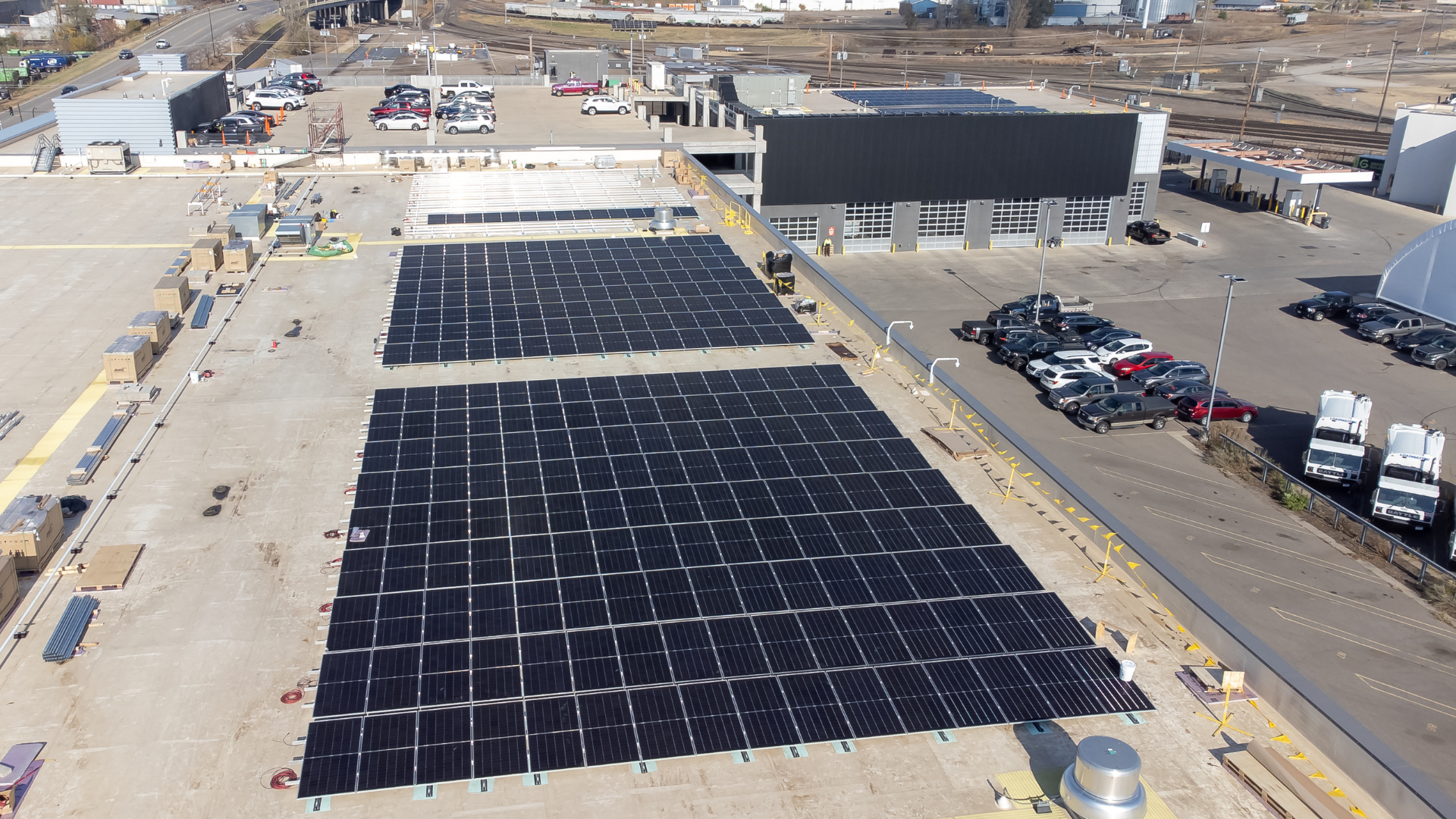
Installing on-site solar is one of the most direct things a business can do to reduce its environmental footprint. It generates clean electricity at the point of use. Every kilowatt-hour produced on-site is one less kilowatt-hour purchased from the grid. The emissions reduction is real, measurable, and verifiable. And unlike many sustainability initiatives, it also reduces operating costs.
For Minnesota businesses watching utility rates climb and evaluating what their energy future looks like, solar is increasingly the place that conversation starts.
.png)
Key Takeaways
- On-site commercial solar provides a measurable, verifiable reduction in purchased grid electricity and associated emissions, making it one of the most practical sustainability investments a business can make
- Solar is increasingly a factor in vendor relationships, tenant decisions, and investor conversations, even for smaller and mid-sized companies
- The environmental and financial benefits are the same investment: one system delivers both
- Minnesota offers a property tax exemption on solar installations and a sales tax exemption on solar equipment, reducing upfront cost and improving ROI
- The federal ITC provides a 30% base credit for commercial projects beginning construction before July 4, 2026, with potential bonus adders up to 40-50%
- Greenway's commercial installations span manufacturing, food and beverage, and distribution, with real client outcomes across Minnesota
Sustainability Has Moved Into Everyday Business Decisions
It was not long ago that sustainability reporting was primarily a concern for publicly traded companies with formal ESG programs. That has shifted. Customers ask about it. Vendors include it in procurement criteria. Employees factor it into where they want to work. Tenants, especially larger ones, evaluate it when choosing commercial space.
According to SEIA's Solar Means Business research, there are now tens of thousands of corporate solar installations across the U.S., with businesses citing both cost reduction and sustainability commitments as primary drivers. The companies leading in solar adoption have long stated that the two goals are not in tension. They are the same investment.
For Minnesota businesses, the practical question isn't whether sustainability matters. It's how to pursue it in a way that is concrete, affordable, and tied to a real operational outcome, rather than a pledge that requires ongoing administration and reporting infrastructure to maintain.
Solar answers that question better than almost anything else.
What Makes Solar a Practical Sustainability Tool
The simplest way to understand solar's sustainability value is to think about where a building's electricity comes from today. Grid electricity in Minnesota is generated from a mix of sources, some of which produce greenhouse gas emissions. Every kilowatt-hour a facility draws from the grid carries an emissions profile tied to that generation mix.
When a facility installs solar and generates electricity on-site, it offsets that grid draw directly. The clean energy produced is consumed first, within the building, before anything goes back to the grid. The reduction in purchased electricity is both the financial benefit and the emissions benefit. They are the same number.
This makes solar different from many sustainability initiatives in two important ways. First, the outcome is immediate and ongoing, not aspirational. Second, it does not require a separate program to sustain. The system runs. The electricity is generated. The grid draw falls.
For companies that need to communicate sustainability performance to customers, tenants, lenders, or internal stakeholders, on-site solar generation provides clean, auditable data. Kilowatt-hours generated on-site. Grid consumption reduced by a specific amount. Emissions avoided over a specific period. No interpretation required.
Hennepin Made, a Minneapolis glass studio and Greenway commercial client, made the decision to maximize on-site generation as a practical matter. As CEO Jackson Schwartz put it: "We use a ton of electricity and Greenway helped us decide on a direction for maximizing our onsite generation using the sun within the code, government incentive programs, and technology selections." The outcome was better energy economics and a cleaner operational footprint, both from the same project.
The Minnesota-Specific Case
Minnesota businesses have several reasons to move on this now, beyond the general sustainability case.
Utility rates have been rising. The Minnesota Public Service Commission approved rate increases for Xcel Energy customers totaling over 13% across 2025 and 2026. Every percentage point of rate increase expands the long-term value of on-site generation. Solar locks in a portion of energy supply at a known cost while grid rates continue to climb.
Minnesota also provides meaningful financial support for commercial solar installations. Solar systems are fully exempt from the state's sales tax on equipment purchases, reducing upfront cost directly. Installed solar is also fully exempt from property tax assessment, meaning the value added to a commercial building does not increase the property tax burden.
These two exemptions, combined with the federal ITC, make Minnesota one of the more financially favorable environments for commercial solar in the Midwest.
The ITC itself remains the most significant financial lever. The base credit is 30% of total installed system cost, applied directly against federal tax liability. Bonus adders for qualifying projects under domestic content and energy community criteria can raise the effective credit to 40-50%. But the window is closing. Commercial projects must begin construction by July 4, 2026 to capture the full credit under current law.
Consult your tax advisor. Based on current IRS guidance under Sections 48/48E.
We covered the ITC deadline mechanics in detail in our post on what the commercial solar incentive window closing actually means for your project.
What "Beginning Construction" Looks Like in Practice
For business owners who hear "July 4, 2026 deadline" and assume that means the full system must be installed and running by then, the actual standard is more accessible. Under the Physical Work Test, a project qualifies if significant physical work of a continuous nature begins by the deadline.
For a commercial installation, this can mean:
- Groundbreaking or foundation work at the site
- Structural racking installation
- Off-site fabrication of custom system components
The key requirements are that the work is significant and that the project continues with no material gaps. Documentation is essential, as the IRS audits these claims. For businesses evaluating solar today, the practical implication is that moving promptly through feasibility, design, and permitting creates the conditions to commence physical work by the deadline.
Given typical commercial project timelines, businesses that have not yet begun this process have a narrow window to capture the full credit.
Sustainability That Also Pays
Ryan Petz, CEO of Fulton Brewing, described Greenway's 310 kW commercial installation as a project that balanced operational performance with environmental commitment: "They went the extra mile to ensure we hit a year end deadline. They have impressed me with their taste in beer and their commitment to helping us improve our environmental impact."
For Fulton, the solar system was both a cost-control move and a direct expression of the company's values. Those two outcomes were always going to coexist. The investment is the same.
That alignment, where financial performance and sustainability performance are driven by the same decision, is what makes solar a particularly practical choice for businesses that want to make progress on their sustainability goals without standing up a separate program to manage them.
The ongoing financial case strengthens the sustainability commitment over time. As utility rates rise, the value of on-site generation grows. The system doesn't require annual reinvestment. It runs, produces electricity, reduces grid draw, and generates data that supports whatever reporting or communication the business needs to do.
For businesses that have spoken to customers, tenants, or lenders about sustainability commitments, an operating solar system provides exactly the kind of concrete, verifiable outcome those conversations call for.
Our post on how commercial solar increases property value and lowers operating costs for Minnesota businesses walks through the financial return side in more depth.
Greenway's Approach to Commercial Projects
We bring more than a decade of commercial solar experience to every project. Our team is NABCEP-certified, we use no subcontractors, and we hold a licensed electrical contractor designation with a registered apprenticeship program. We manage the full project scope from initial feasibility through design, permitting, installation, interconnection, and incentive management.
We partner closely with architects, general contractors, and engineers, which matters for commercial projects where the solar system interacts with existing building systems, structural load requirements, and utility interconnection schedules. Every system is designed around the specific building, load profile, and financial goals of the business.
Commercial clients like Fulton Brewing, Hennepin Made, and SunOpta trusted us with meaningful projects. We treat that trust as the metric we're accountable to, which is why our work consistently generates referrals and repeat clients.
If you're ready to understand what on-site solar would look like for your facility, our overview of how to compare commercial solar proposals is a useful starting point.
FAQs
Does a business need a formal ESG program to benefit from commercial solar?
No. The environmental and financial outcomes of on-site solar are real regardless of whether a company has a formal sustainability reporting program. The system generates clean electricity, reduces grid purchases, and produces verifiable data. Businesses can use that data for reporting, for stakeholder communication, or simply for internal tracking. No program overhead required.
What is the relationship between solar and Scope 2 emissions reductions?
Scope 2 emissions are the indirect greenhouse gas emissions associated with purchased electricity. When a facility generates its own electricity from solar and reduces its grid draw, it directly lowers its Scope 2 emissions. The reduction is proportional to the share of consumption offset by solar generation and is measurable from the system's production data.
How does the Minnesota property tax exemption work for commercial solar?
Minnesota fully exempts solar energy systems from property tax assessment. This means the value a solar system adds to a commercial building does not increase the building's assessed value for property tax purposes. The system adds real estate and operational value without a corresponding increase in the annual tax burden.
What commercial sectors has Greenway served in Minnesota?
Greenway has installed commercial systems for clients in brewing (Fulton Brewing, 310 kW), manufacturing (Hennepin Made), food production (SunOpta), and marketing services (Impact Marketing), among others. We design scalable solutions from rooftop arrays to multi-megawatt ground mounts and solar gardens.
Is battery storage necessary for a sustainability-focused commercial solar project?
Not necessarily. A solar-only system still delivers meaningful emissions reductions and energy cost savings by offsetting daytime grid consumption. Adding battery storage provides additional benefits, including demand charge reduction, backup power capability, and greater energy independence, which may align with resilience and operational continuity goals. The right configuration depends on the facility's load profile, utility rate structure, and operational priorities.
If you have been thinking about what solar could mean for your facility's energy costs and sustainability profile, we would welcome the chance to look at your situation directly. Reach out at Info@GreenwaySolar.org or call (612) 416-1518 to start a conversation.
Fill out our client inquiry form today, so we can reach out and help you start taking advantage of the many benefits of solar!
Here at Greenway, we believe in solar for all. For homeowners, we install standard solar panels, EV chargers, battery storage, and the SPAN panel. We are also a certified installer of the Tesla Solar Roof and Powerwall. If you don’t own a home but want the benefits of solar, then subscribing to one of our three community solar gardens might be right for you.
Certified to Install:


More to Read
More posts are coming soon! Sign up using the form below to be notified.

Your Electric Bill Went Up and You Didn't Use More Power. Here Is Why.

Here's How Commercial Solar Systems Are Actually Sized in Minnesota
The Difference Between a Solar Installer and a Solar Partner
Get Greenway Updates in Your Inbox.
Enter your email to receive notifications of new posts.