

Why Solar Pays Back Faster for Some Commercial Buildings Than Others

A warehouse owner and a restaurant owner will both benefit from commercial solar. But they will benefit in different ways, on different timelines, and for different reasons.
That distinction matters because most commercial solar content treats every business the same. The reality is that your building type, your operating hours, your load profile, and how you use electricity all shape what solar can actually do for you. A system designed for a steady daytime load in an office building is a fundamentally different proposition than a system designed for a brewery with heavy thermal loads or a restaurant with an evening demand peak.
Understanding how your building uses energy is the starting point for understanding how solar pays for itself.
Key Takeaways
- Different commercial building types have different energy profiles, and those profiles directly shape solar ROI
- Warehouses and distribution centers typically see the fastest payback because of large roof areas and steady daytime loads
- Breweries and food producers benefit from high daytime energy consumption that aligns well with solar production
- Office buildings have consistent weekday demand that matches solar output, making them reliable performers
- Restaurants and retail face a different challenge because their peak demand often falls in the evening, making battery storage a more important part of the equation
- Greenway designs every commercial system around the building's actual energy profile, not a one-size-fits-all template
Warehouses and Distribution Centers
Warehouses are among the strongest candidates for commercial solar. The reasons are practical:
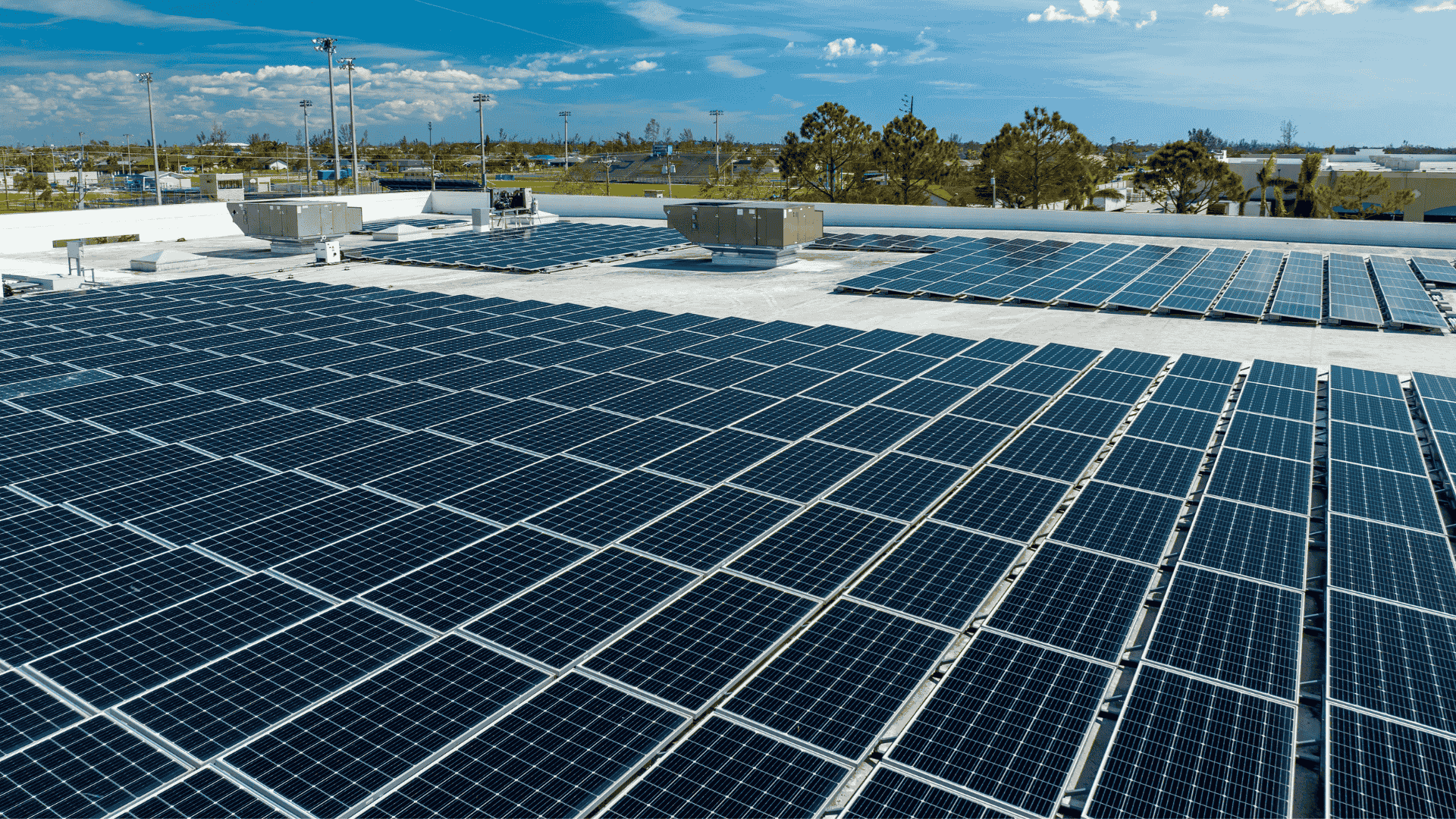
- Large, flat roofs with minimal obstructions provide maximum usable area for panels. EPA data shows that warehouse and storage buildings can meet a higher percentage of their electricity needs from on-site solar than almost any other building type.
- Steady daytime loads from lighting, climate control, and dock operations align directly with solar production hours. The system generates power when the building needs it most.
- Low complexity. Warehouses typically have straightforward electrical systems without the high peak-demand spikes that complicate solar sizing in other building types.
For warehouse operators, solar often delivers the most predictable return because the alignment between production and consumption is so direct. Add battery storage for demand charge management and the financial case gets even stronger.
Breweries and Food Producers
Energy-intensive operations like breweries, food processing facilities, and manufacturing plants use large amounts of electricity during business hours. Refrigeration, heating, cooling, and production equipment run consistently during the day, creating a load profile that matches solar production well.
Greenway has installed systems for several Minnesota businesses in this category. Fulton Brewing operates a 310 kW commercial system. As Ryan Petz, CEO of Fulton Brewing, described the project: "Greenway managed a tight timeline and some nasty winter weather to finish a 310kW system. They went the extra mile to ensure we hit a year end deadline."
Hennepin Made, a glass studio that uses significant electricity for its furnaces, also worked with Greenway. Jackson Schwartz, CEO, put it this way: "We use a ton of electricity and Greenway helped us decide on a direction for maximizing our onsite generation using the sun within the code, government incentive programs, and technology selections."
What makes these operations strong solar candidates is not just the volume of electricity they use, but when they use it. High daytime consumption means a higher share of solar production is consumed on-site, which maximizes direct savings and minimizes reliance on net metering credits.
For energy-intensive businesses managing how demand charges affect their operating costs, pairing solar with battery storage creates the deepest savings by addressing both energy charges and peak demand.
Office Buildings
Office buildings have one of the most consistent energy profiles in commercial real estate. Lights, HVAC, computers, and elevators run on a predictable weekday schedule that closely mirrors solar production hours.
This makes office buildings reliable solar performers:
- Predictable weekday demand means solar production is consumed during the hours the building needs it most
- Steady load profiles without the extreme peak spikes seen in manufacturing or food production simplify system design
- Multi-tenant appeal. For building owners, solar reduces operating costs and strengthens the property's financial profile. For tenants, lower energy costs and a sustainability commitment are increasingly part of the leasing decision
The opportunity for office buildings is less about massive energy savings and more about consistent, predictable cost reduction over decades. It's the building type where solar most clearly functions as a long-term financial asset rather than a short-term cost play.
For commercial property owners exploring the broader asset value story, we covered how solar increases property value and lowers operating costs in a recent blog.
Restaurants and Retail
Restaurants and retail spaces face a different challenge. Their highest energy demand often falls in the evening, when solar production has dropped off. Kitchens running at full capacity during dinner service, evening lighting, and late-hour HVAC loads all pull heavily from the grid after the sun goes down.
This does not mean solar doesn't work for restaurants. It means the system design needs to account for the timing mismatch:
- Battery storage becomes a more important piece of the system. Solar charges the battery during the day, and the battery discharges during the evening peak, shifting solar value into the hours when the building needs it most.
- Daytime pre-cooling and pre-heating strategies can use solar power during production hours to reduce HVAC load during the evening, capturing more value from solar when it's available.
- Demand charge management through storage still applies. Even though the peak shifts later in the day, battery discharge during those hours prevents the spikes that set demand charges.
For restaurants and retail, solar paired with storage is the combination that makes the ROI work. The system requires more planning than a warehouse or office installation, but the financial case holds when designed around the building's actual load profile.
How Greenway Approaches This
Every commercial building Greenway works with gets a system designed around how the building actually uses energy. Not a template. Not a generic calculation. An honest assessment of the load profile, peak demand patterns, roof or site conditions, and the right combination of solar, storage, and load management for that specific operation.
This is the same approach we bring to every project, from evaluating solar proposals to managing the full commercial timeline. Our NABCEP-certified team uses advanced design software, runs conservative production estimates, and builds systems with direct employees only, no subcontractors.
The federal ITC still delivers meaningful tax credits for commercial solar projects that begin construction by July 4, 2026. With the credit, commercial solar typically reaches payback in 5 to 7 years regardless of building type. Consult your tax advisor. Based on current IRS guidance under Sections 48/48E.
FAQs
Which building type gets the best solar ROI?
Warehouses and distribution centers typically see the fastest payback because of large roof areas and steady daytime loads. But every building type can achieve strong returns when the system is designed around the building's specific energy profile.
Does solar work for restaurants with evening peak demand?
Yes, but battery storage is an important part of the system. Solar charges the battery during the day, and the battery discharges during the evening peak. This shifts solar value into the hours when the building needs it most and helps manage demand charges.
How does Greenway determine what system is right for my building?
We start with your utility data and load profile. We assess your roof or site conditions, map peak demand patterns, and design a system sized for how your building actually operates, not a generic estimate. Every system is designed with conservative production modeling using advanced solar design software.
Can I combine solar with storage for demand charge management regardless of building type?
Yes. Battery storage benefits any commercial building that pays demand charges. The specific sizing and discharge strategy will differ based on your load profile, but the principle applies to warehouses, offices, breweries, restaurants, and retail spaces alike.
If you are curious about what solar could do for your specific building and operation, we would welcome the chance to look at your energy profile. Every building is different, and an honest assessment is the best place to start. Reach out at Info@GreenwaySolar.org or call (612) 416-1518.
Fill out our client inquiry form today, so we can reach out and help you start taking advantage of the many benefits of solar!
Here at Greenway, we believe in solar for all. For homeowners, we install standard solar panels, EV chargers, battery storage, and the SPAN panel. We are also a certified installer of the Tesla Solar Roof and Powerwall. If you don’t own a home but want the benefits of solar, then subscribing to one of our three community solar gardens might be right for you.
Certified to Install:


More to Read
More posts are coming soon! Sign up using the form below to be notified.

Your Electric Bill Went Up and You Didn't Use More Power. Here Is Why.

Here's How Commercial Solar Systems Are Actually Sized in Minnesota
The Difference Between a Solar Installer and a Solar Partner
Get Greenway Updates in Your Inbox.
Enter your email to receive notifications of new posts.