

Here's How Commercial Solar Systems Are Actually Sized in Minnesota

A business owner walks into a solar conversation expecting a sales pitch. What they usually get is a number: system size in kilowatts, estimated annual production, projected savings. What they rarely get is an explanation of how that number was actually built.
That gap matters. A system sized around what looks good in a proposal is different from one sized around how your building actually uses energy. The first one might win the bid. The second one performs for 25 years.
Here is how we approach sizing, and what every Minnesota business owner should understand before they sign anything.

Key Takeaways
- Four inputs drive commercial solar system sizing: annual energy consumption, usable roof or ground space, load profile timing, and utility interconnection limits.
- Minnesota has state-specific structural load requirements that affect every commercial rooftop installation. Understanding them early prevents expensive design surprises.
- Panel efficiency determines how much power you can generate from a given roof area. On constrained commercial rooftops, that choice directly affects system size.
- Production estimates built on honest assumptions outperform estimates built to win proposals. The difference shows up in year three, not year one.
- System size and system value are not the same thing. A smaller, accurately designed system often outperforms a larger one built on optimistic assumptions.
The 4 Inputs That Determine System Size
Every commercial solar design starts with the same four questions.
How much electricity does the building use annually? How much usable roof or ground space is available? When during the day does the business draw power most heavily? And what does the local utility allow in terms of interconnected capacity?
Each input affects the final design differently:
- Annual energy consumption sets the ceiling. We are sizing to offset a meaningful share of your actual usage, not to maximize panel count.
- Load profile timing determines how much production you capture directly versus send back to the grid.
- Roof space sets the physical constraint on what can be installed.
- Interconnection limits from Xcel Energy, or your utility, can cap system size independent of what the building could otherwise support.
Get one of these wrong and the system ends up oversized relative to what you can use, undersized relative to what you need, or flagged during utility review after the design is already finished. We work through all four before a single panel gets placed in a layout.
Jackson Schwartz, CEO of Hennepin Made, described what a rigorous sizing conversation looks like from the client side: "We use a ton of electricity and Greenway helped us decide on a direction for maximizing our onsite generation using the sun within the code, government incentive programs, and technology selections."
That phrase, within the code, is the part most business owners do not see coming. Sizing does not happen in a vacuum. It happens inside a real set of structural, electrical, and utility constraints.
If you are still working through whether solar fits your building at all, we covered the full decision framework in our post on whether solar is right for your business right now (https://www.greenwaysolar.org/blog/is-solar-right-for-your-business-right-now).
What Roof Space Actually Allows
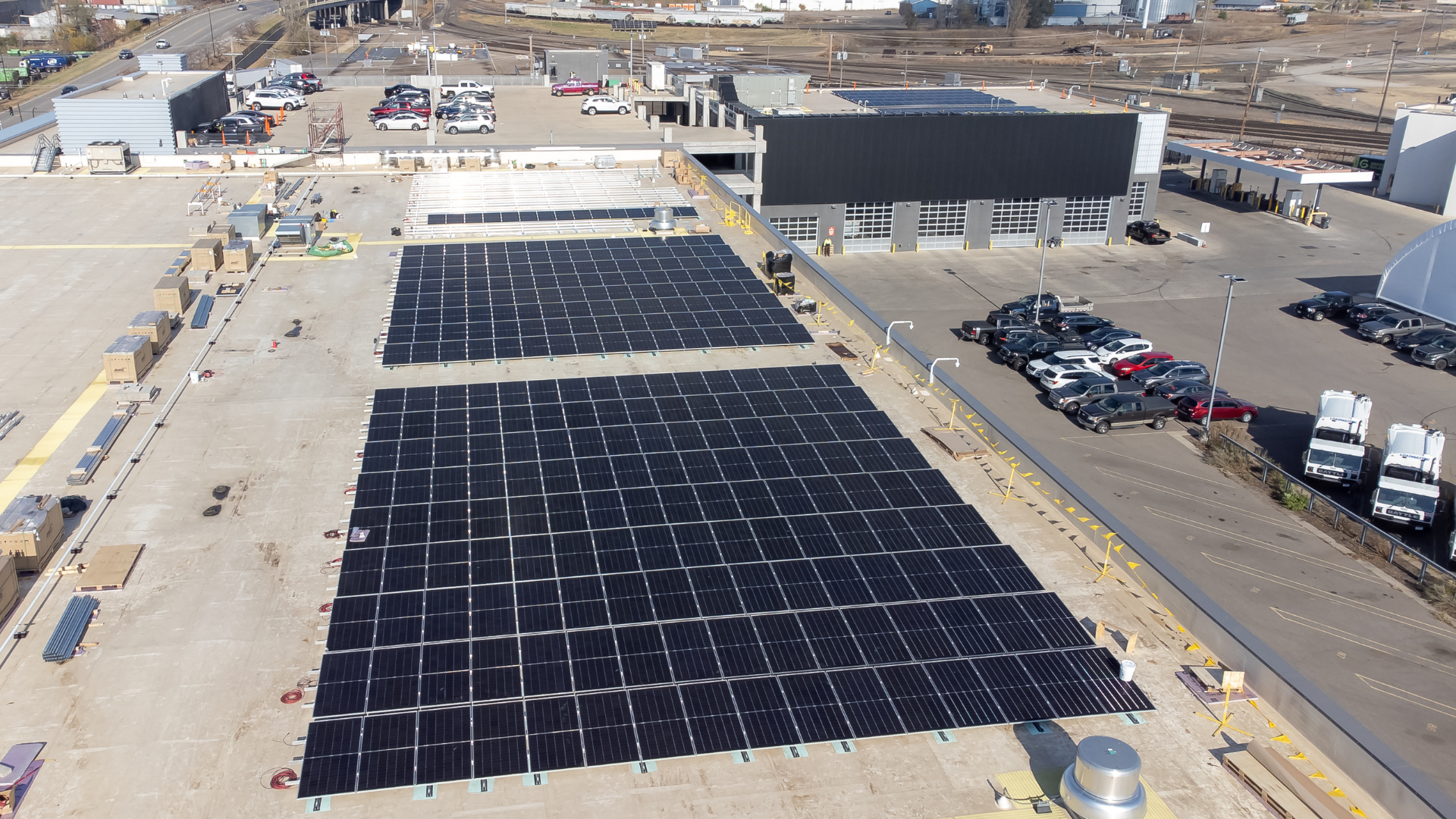
Minnesota's solar design guidelines establish a practical rule of thumb: plan for 100 to 150 square feet of usable roof area per kilowatt of installed capacity. A 100 kW system needs roughly 10,000 to 15,000 square feet of clean, unobstructed surface. A 310 kW system, like the one we installed for Fulton Brewing, requires a significantly larger industrial footprint.
Usable is the key word.
Rooftop HVAC equipment, skylights, drainage paths, access pathways, parapets, and setback requirements all reduce the area that can actually hold panels. Older flat-membrane commercial roofs often have more constraints than they appear to on a site plan. We assess every roof condition directly rather than relying on satellite imagery, because the difference between an estimated and an actual usable area can shift a system size meaningfully.
Panel efficiency also plays into this. Higher efficiency panels generate more power per square foot, which can allow a larger system on a constrained roof. On a 20,000 square foot flat roof with significant obstructions, the difference between 20% and 22% efficient panels can mean the difference between a 150 kW and a 175 kW system. That is not a trivial distinction when you are trying to maximize offset on a fixed footprint.
Minnesota's Structural Requirements Are Not Optional
Every commercial rooftop solar installation in Minnesota must be assessed against standardized load tables developed by the Minnesota Department of Labor and Industry and Minnesota Department of Commerce. These tables ensure the additional weight of a solar system does not stress a roof structure beyond safe limits. If a building's roof framing is not covered by the standardized tables, a structural engineer must certify the design before installation can proceed.
This requirement applies to every installer in the state. What varies is when in the process it gets addressed.
Finding a structural issue after a system has been fully designed is expensive and causes delays. Finding it before design begins means sizing can be adjusted to work with the actual building. We treat the structural assessment as part of design, not a downstream checkbox. It informs the racking approach, the panel layout, and whether any sections of the roof need to be avoided entirely.
How Production Estimates Get Built Honestly
The production estimate in a solar proposal is a projection. It is based on your location, roof orientation, shading conditions, panel specs, and historical solar resource data. Minnesota receives an average of 4 to 4.5 peak sun hours per day across the state, comparable to several European markets with strong solar adoption. That resource is real and consistent enough to build reliable projections around.
What varies is how honestly those projections are built.
We use Aurora Solar design software, which integrates shade analysis, production modeling, and panel layout in a single design environment. The shade analysis matters particularly on commercial rooftops with significant obstructions. A rooftop mechanical unit that affects a row of panels for three hours a day shows up in the model. An estimate that ignores it looks better on paper and disappoints in practice.
Our approach is to build every estimate conservatively. We would rather have a system outperform its projection in year two than spend year one explaining why it came up short. For a deeper look at how building type and load profile affect real-world performance, our post on why solar pays back faster for some commercial buildings than others walks through the variables in detail (https://www.greenwaysolar.org/blog/why-solar-pays-back-faster-for-some-commercial-buildings-than-others).
What the Design Process Looks Like in Practice
Once the four inputs are gathered and the structural and interconnection assessments are complete, the design moves into the layout phase. Aurora Solar allows us to model exact panel placement on a to-scale roof layout, optimize string configurations for the inverter setup, and produce a final production estimate tied to the actual design rather than a generic square footage assumption.
From that point the design gets reviewed against utility interconnection requirements and submitted for permitting. Permitting timelines vary by municipality. We manage both processes end to end so the business owner is not tracking two approval workstreams on top of running their business.
The system that comes out of this process is sized around your building, your load, your utility relationship, and what the structure can actually support. That specificity is what makes the production estimate reliable, and it is what keeps the relationship in good shape five and ten years down the road.
For businesses that have already gone solar and are thinking about what comes next, our post on what happens when a Minnesota business adds solar and then needs to expand covers the growth side of the conversation (https://www.greenwaysolar.org/blog/what-happens-when-a-minnesota-business-adds-solar-and-then-needs-to-expand).
Frequently Asked Questions
How do I know what size system my building needs?
Start with your last 12 months of utility bills. Annual kilowatt-hour consumption is the primary input. From there, a professional site assessment covering roof space, shading conditions, and structural capacity defines what the building can physically support. Your utility's interconnection limit sets the ceiling. All four inputs together produce a design sized for your situation, not a generic building profile.
Does roof orientation matter for commercial systems?
Yes, significantly. South-facing arrays at a pitch of 35 to 37 degrees produce the highest annual yield in Minnesota. Many commercial flat rooftops allow racking to be tilted and oriented for optimal production regardless of the underlying roof direction. East and west-facing surfaces can contribute meaningfully in large commercial systems where maximizing coverage is a priority.
What happens if my roof cannot support the system size we want?
The structural assessment early in the design process surfaces these constraints before they become costly problems. Options include reducing the system footprint, using higher efficiency panels to generate more power from the available area, adding ground-mounted capacity if the site allows, or phasing the installation around structural remediation work.
How does utility interconnection affect system size?
Minnesota utilities review every commercial solar interconnection request. The approved system size may be limited based on grid capacity in a specific service area, independent of what the roof and load would otherwise support. We work through interconnection review as part of the design process so that the system we propose is one that can actually be approved and connected.
Start With a Site Assessment
If you are trying to understand what solar looks like for your specific building, the most useful first step is a direct conversation followed by a professional site assessment. We can tell you what the building supports, what it does not, and what a realistically sized system would actually produce.
Reach out at Info@GreenwaySolar.org or call (612) 416-1518.
Fill out our client inquiry form today, so we can reach out and help you start taking advantage of the many benefits of solar!
Here at Greenway, we believe in solar for all. For homeowners, we install standard solar panels, EV chargers, battery storage, and the SPAN panel. We are also a certified installer of the Tesla Solar Roof and Powerwall. If you don’t own a home but want the benefits of solar, then subscribing to one of our three community solar gardens might be right for you.
Certified to Install:


More to Read
More posts are coming soon! Sign up using the form below to be notified.

Your Electric Bill Went Up and You Didn't Use More Power. Here Is Why.
The Difference Between a Solar Installer and a Solar Partner
.png)
Is Solar Right for Your Business Right Now
Get Greenway Updates in Your Inbox.
Enter your email to receive notifications of new posts.