

Is Solar Right for Your Business Right Now

You've looked at the utility bill. You've thought about solar, maybe more than once. Then you've gone back to running your business.
That cycle is more common than most solar companies would admit. The pitch for commercial solar is almost always framed as an obvious yes. The more useful question is a specific one: is it right for your business, with your building, at this moment?
The answer is not always the same. It depends on how you use electricity, what your building can support, and how your utility bill is structured. This post walks through each of those factors honestly, with examples from Minnesota businesses that have already worked through the same questions.
.png)
Key Takeaways
- Businesses that draw steady power during daylight hours typically see the strongest solar returns
- Your building does not need to be perfect. Roof condition, orientation, and ground space all factor in, and more options exist than most owners expect
- The structure of your utility bill matters as much as the total amount. Demand charges can make solar and storage significantly more valuable
- Minnesota's property tax and sales tax exemptions improve the economics in ways most national solar content never mentions
- The right installer tells you honestly when the fit is not right, not just runs the math until it looks good
Start With How You Actually Use Energy
Solar generates electricity when the sun shines. That sounds obvious, but it has a practical implication that changes the financial case significantly. A business drawing steady power during daylight hours captures most of its solar production directly. That direct offset is where the savings come from.
A brewery running production lines from 7 a.m. to 6 p.m. is a near-perfect candidate. A manufacturer on three shifts including overnight is still strong, but the overnight draw comes from the grid regardless. A restaurant doing most of its business in the evenings has a different profile entirely.
This is why we start every commercial engagement with a load analysis, not a sales call. Jackson Schwartz, CEO of Hennepin Made, described it well: "We use a ton of electricity and Greenway helped us decide on a direction for maximizing our onsite generation using the sun within the code, government incentive programs, and technology selections." The question was never just whether to go solar. It was how to design a system around how the business actually uses energy.
Businesses that tend to be strong candidates:
- Manufacturers with daytime production schedules
- Breweries, food producers, and cold storage operations
- Office buildings and commercial properties with standard business hours
- Retail and hospitality facilities with consistent daytime load
Businesses with heavy nighttime draw or highly variable load profiles are not poor candidates. They may simply need a different system design, often one that includes battery storage to shift and capture more of the solar value.
What Your Building Can and Cannot Support
Most commercial solar lives on rooftops. That means roof condition, structural capacity, and orientation all matter. A roof due for replacement in two to three years is a problem if solar goes on first. Heavy shading from adjacent buildings or rooftop equipment will reduce production meaningfully.
None of this is automatically disqualifying. It shapes the design.
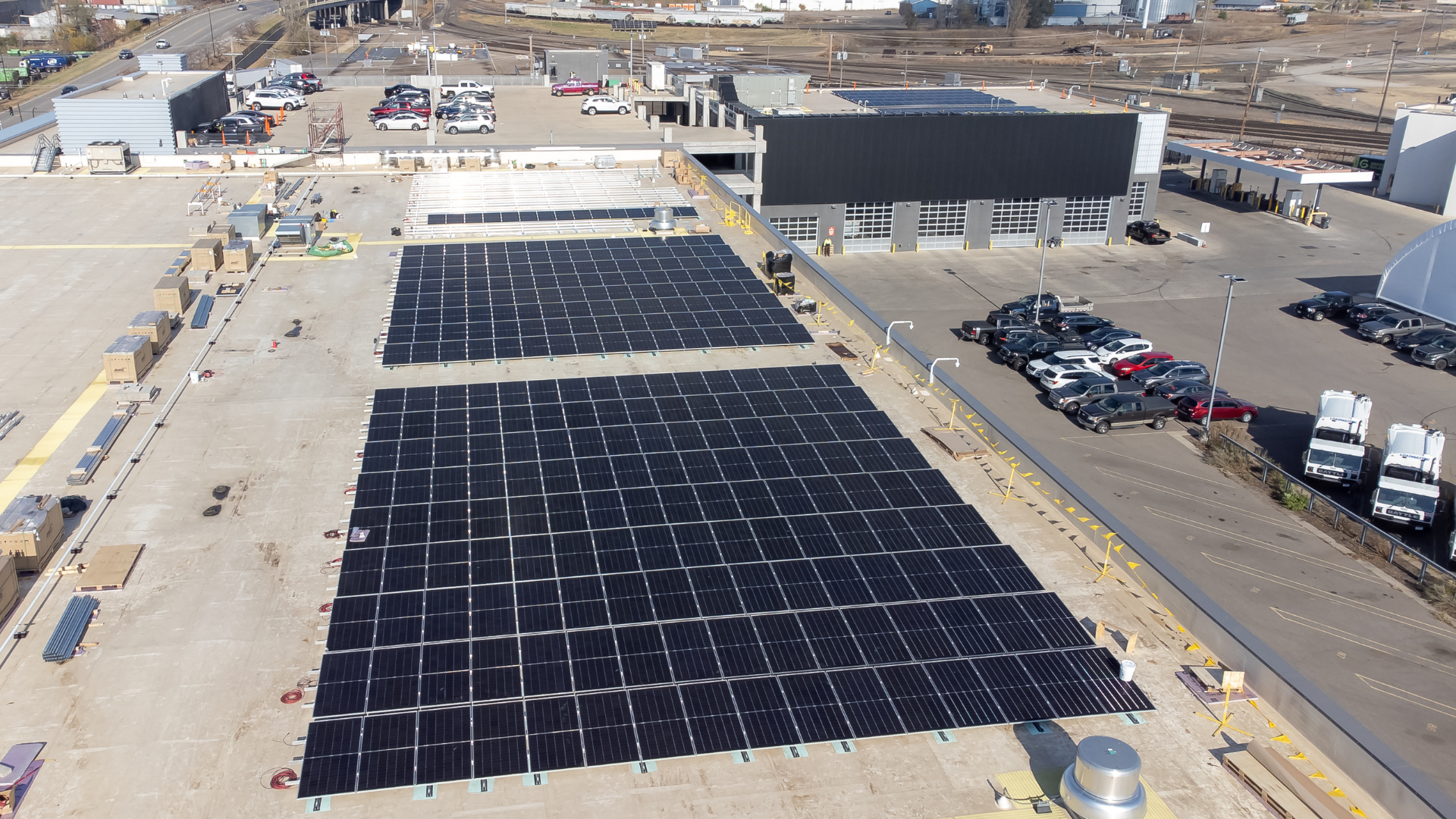
A flat commercial roof in good condition with open southern exposure is the simplest case. Rooftops with obstructions, sub-optimal orientation, or structural concerns require more design work, but they often still support a viable system once the numbers are run accurately. Ground-mounted systems and solar carports are real alternatives when a rooftop is not the right fit. We have designed and installed systems across all three configurations for commercial clients across Minnesota.
The most important thing at this stage is an honest assessment. We use the most advanced shade analysis and production modeling software available and build every estimate conservatively. We would rather under-promise and over-deliver than win a proposal on numbers that look good in a spreadsheet but disappoint in year three.
The Line on Your Bill That Matters Most
Two businesses can pay the same monthly total to their utility and face very different solar economics. The reason is demand charges.
A demand charge is based not on how much electricity you use, but on the peak rate at which you draw it. A single 15-minute spike in consumption can set your demand charge for the entire billing cycle. For energy-intensive facilities, this line item can represent a substantial share of the total bill.
Here is how solar and storage change that picture:
- Solar alone reduces the draw that registers during your peak demand window, when production coincides with peak usage
- Battery storage charges during low-cost, off-peak hours and discharges at your peak window, flattening the spike before it registers
- Solar plus storage addresses both the energy charge and the demand charge simultaneously, producing the deepest and most consistent savings
Understanding your bill structure before designing a system is essential. A solar-only design built for a facility where demand charges dominate will underperform expectations. A solar-plus-storage design built for the same facility can deliver meaningfully different results.
Two Minnesota Advantages Most National Content Misses
Minnesota has two solar-specific tax provisions that change the financial math in ways most generic solar content never addresses.
Under Minnesota Statute 272.02, a solar energy system is fully exempt from property tax assessment. When solar adds value to your building, that increased value does not trigger a higher tax bill. The asset appreciates. The tax does not.
Under Minnesota Statute 297A.67, solar system components are exempt from state sales tax. At 6.875%, that exemption reduces your upfront cost at the time of purchase.
These two provisions do not exist in every state. For a Minnesota business weighing the full financial picture, they meaningfully improve the economics beyond what national ROI comparisons suggest. They also stack with federal incentives, utility programs, and any applicable rebates. We manage the full incentive picture as part of every commercial project, because leaving any of it on the table is not something we are comfortable with.
Consult your tax advisor regarding your specific situation and eligibility.
The Time Horizon Is Part of the Answer
Solar is a long-term infrastructure investment. The systems we install are designed to perform for 25 to 30 years. That means the financial case is built on a horizon most businesses do not normally apply to an operating expense.
For businesses that own their buildings, the long-term case is straightforward. For businesses that lease, the conversation requires looking at lease terms, landlord relationships, and what the remaining tenure can support. It is a real variable, and we address it directly rather than glossing over it.
Ryan Petz, CEO of Fulton Brewing, described what a well-executed commercial installation looks like when the timeline is tight and the stakes are real: "Greenway managed a tight timeline and some nasty winter weather to finish a 310kW system. They went the extra mile to ensure we hit a year end deadline."
That is one situation. Yours will be different. The starting point is always the same: an honest look at whether the numbers and the circumstances actually support a decision.
When the Honest Answer Is Not Yet
There are real situations where a business is not a strong commercial solar candidate at a given moment. A roof with two years of useful life left. A lease with eighteen months remaining. A load profile that is primarily nighttime or highly variable.
None of these are permanent obstacles. They are timing and design questions.
A business that is not ready today may be a strong candidate after a roof replacement, a lease renewal, or a change in operations. The honest version of "is solar right for you" includes the possibility that the answer is "not yet, and here is why." That transparency is more useful than a proposal built around assumptions that bend toward yes.
FAQs
Does my business need to own its building to go solar?
Ownership makes the conversation simpler, but it is not the only path. Some commercial leases support solar installations, particularly when the landlord is open to a conversation about long-term property improvements. We work through lease structures regularly and can help assess what your specific situation supports.
How accurate are solar production estimates?
Production estimates are projections based on your location, roof orientation, shading conditions, and historical solar data. We use the most advanced design software available and build our estimates conservatively. The goal is to under-promise and over-deliver, not to win proposals on numbers that disappoint once the system is running.
What is the difference between energy savings and demand charge savings?
Energy savings come from generating electricity you would otherwise buy from the grid. Demand charge savings come from reducing the peak rate at which you draw power. For many commercial facilities, demand charges are a significant share of the total bill. A well-designed system addresses both, and battery storage can extend the demand charge reduction beyond what solar alone provides.
Does commercial solar still make financial sense in 2026?
Yes. Commercial solar remains eligible for federal incentives through IRS Sections 48 and 48E, and Minnesota's property and sales tax exemptions remain in place. The long-term energy savings case is unaffected by recent incentive changes. Consult your tax advisor for specifics relevant to your business.
If you have been turning the solar question over in your head, the most useful next step is a direct conversation about your specific situation. If solar is a strong fit for your business, we will tell you exactly why and show you what it looks like. If the timing or circumstances are not right, we will tell you that too.
Reach out at Info@GreenwaySolar.org or call (612) 416-1518.
Fill out our client inquiry form today, so we can reach out and help you start taking advantage of the many benefits of solar!
Here at Greenway, we believe in solar for all. For homeowners, we install standard solar panels, EV chargers, battery storage, and the SPAN panel. We are also a certified installer of the Tesla Solar Roof and Powerwall. If you don’t own a home but want the benefits of solar, then subscribing to one of our three community solar gardens might be right for you.
Certified to Install:


More to Read
More posts are coming soon! Sign up using the form below to be notified.

Your Electric Bill Went Up and You Didn't Use More Power. Here Is Why.

Here's How Commercial Solar Systems Are Actually Sized in Minnesota
The Difference Between a Solar Installer and a Solar Partner
Get Greenway Updates in Your Inbox.
Enter your email to receive notifications of new posts.