

Solar and Storage for Minnesota Businesses Before Utility Rates Climb Higher

You opened your facility's electricity bill last month and noticed the total was higher than the same month a year ago. Usage was about the same. The rate was not.
This is not a blip. National commercial electricity rates rose roughly 5% year-over-year through early 2026, and Minnesota is not exempt. Xcel Energy has proposed new electric rates for its Minnesota customers, and the trajectory is pointing in one direction. Natural gas costs are climbing. Grid modernization requires investment. Demand from data centers and electrification is growing. Utilities pass those costs through, and your business absorbs them.
The businesses that insulate themselves from this trend are the ones locking in energy costs now, through on-site solar generation and battery storage that reduce both how much grid power they buy and how much they pay during peak demand. The math is straightforward, and for the next five months, the federal Investment Tax Credit makes it even better.

Key Takeaways
- National commercial electricity rates increased roughly 5% year-over-year, with further increases projected through 2026 and beyond
- On-site solar reduces energy charges by generating power during business hours when consumption is highest
- Battery storage reduces demand charges, often the most expensive line item on a commercial electricity bill, by shaving peak demand
- Solar paired with storage addresses both charges simultaneously for deeper long-term savings
- The 30% federal ITC (with bonus adders up to 50%) requires beginning construction by July 4, 2026
- Typical commercial solar payback is 5 to 7 years with the ITC, with savings continuing for 30+ years
- A Wood Mackenzie analysis found that rising retail rates could reduce commercial solar payback periods by 33%
1. The Two Charges on Your Commercial Bill That Solar and Storage Address
Most business owners look at the total on their electricity bill. The structure underneath matters more.
Commercial electricity bills typically have two main components. Energy charges are based on total kilowatt-hours consumed over the billing period. These are what most people think of as "the electricity bill." Demand charges are based on your highest instantaneous power draw during a specific window, usually measured in 15-minute intervals during peak hours. One spike, even a brief one, can set your demand charge for the entire month.
Demand charges are often the most expensive part of a commercial bill, and they are the hardest to control without the right equipment. Running the compressor, the HVAC system, and the production floor at the same time during a peak window sets a high-water mark that you pay for all month.
Solar addresses the energy charge side. On-site generation offsets grid consumption, especially during business hours when the sun is strongest and your facility is running. Battery storage addresses the demand charge side by discharging during peak periods to flatten your load profile and reduce that high-water mark. Together, they cut both sides of the bill.
2. Four Demand Charge Scenarios From Full Exposure to Maximum Savings
Greenway models demand charge reduction for commercial clients across four configurations. Each one represents a real approach we design and install.
Grid only (full exposure). No solar, no storage. Your business pays standard energy charges plus peak demand charges determined by your highest usage spikes. This is the most expensive scenario and the one most businesses currently operate under.
Storage only (peak shaving). Battery storage charges during low-cost off-peak hours and discharges during peak demand periods. Your operations do not change. The battery handles the load shifting. Demand charges drop significantly.
Solar only (offset and peak alignment). On-site solar generation reduces grid reliance during daylight hours. When solar production coincides with high energy use, it naturally lowers peak demand. This trims energy costs without batteries, though the demand charge reduction depends on how well production aligns with your peak windows.
Solar plus storage (maximum savings). Solar generates on-site power to offset daytime energy use. Excess solar charges the battery. The battery discharges during peak times. Both energy usage and demand charges get cut. This is where the deepest long-term savings live.
3. Why Rising Rates Make the Case Stronger
The financial case for commercial solar has always been about long-term savings. Rising electricity rates accelerate the math.
A Wood Mackenzie analysis published in early 2026 found that increasing average annual retail rate growth from 2% to 6% reduces the national average payback period for commercial solar from 6.3 years to 4.2 years. That is a 33% reduction in time to recoup your investment, driven entirely by the escalating cost of doing nothing.
In Minnesota specifically, the trend is clear. Xcel Energy proposed new rates for 2025 and 2026 to fund grid reliability improvements, clean energy projects, nuclear plant maintenance, and system expansion for growing electricity demand. Whether those rates are approved as proposed or adjusted, the direction is the same: business electricity costs are going up.
Solar locks in a predictable generation cost for decades. Once your system is installed, the energy it produces costs you nothing beyond maintenance. Battery storage adds a second layer of insulation by controlling when you pull from the grid and what you pay for it. Together, they create a hedge against rate volatility that no utility plan can match.
4. The ITC Accelerates Your Payback
The 30% federal Investment Tax Credit applies to commercial solar and storage projects, and it is the single largest accelerator of project economics.
On a $400,000 commercial solar installation, the base 30% credit represents $120,000 in direct tax liability reduction. With bonus adders for domestic content (+10%) and energy community location (+10%), the credit can reach 40-50% of total project costs. Prevailing wage and apprenticeship compliance is required for the full base rate on larger systems.
Greenway's registered apprenticeship program and licensed electrical contractor status support compliance with these requirements. We also handle MACRS accelerated depreciation documentation, which allows businesses to depreciate solar assets over five years for additional tax savings.
The critical deadline: projects must begin construction by July 4, 2026 to qualify. The 5% safe harbor method (paying 5% of total costs on equipment) is the simplest path and gives you until December 31, 2030 to complete installation.
Consult your tax advisor. Based on current IRS guidance under Sections 48/48E.
5. What Greenway Brings to Commercial Projects
Greenway has been delivering commercial solar systems across Minnesota and the Midwest for over a decade. Our approach is built around a few things that matter for commercial clients.
We manage the full scope. Feasibility, design, permitting, installation, interconnection, and incentive management happen under one roof. We partner closely with architects, general contractors, and engineers to deliver systems that meet technical, financial, and aesthetic goals. Our NABCEP-certified in-house team uses only direct employees, never subcontractors.
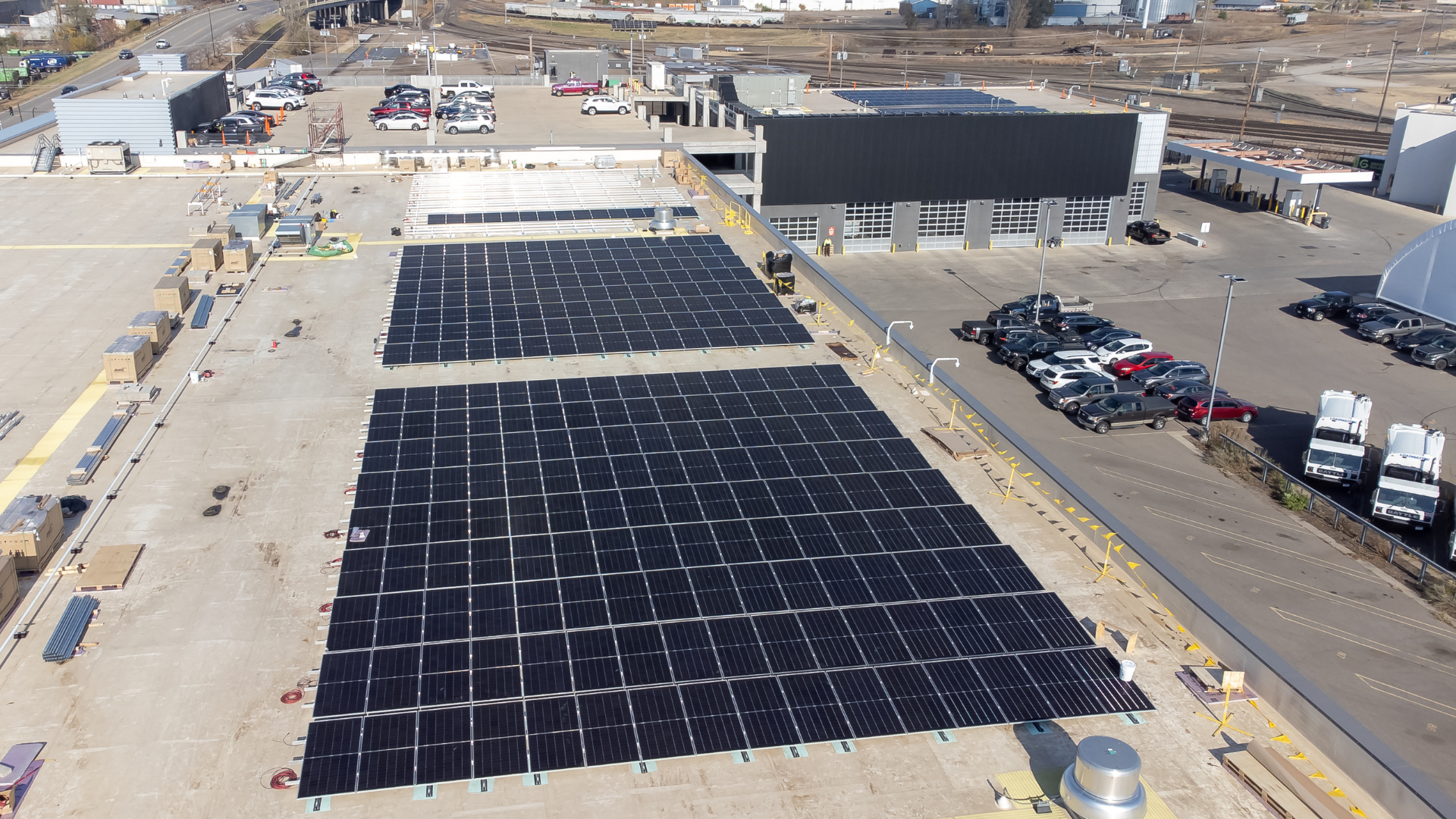
Our commercial portfolio includes Fulton Brewing (310 kW system delivered on a tight timeline through winter weather), Hennepin Made (maximizing on-site generation within code and incentive constraints), SunOpta, and North Market. These are real projects with real operational results.
As Ryan Petz, CEO of Fulton Brewing, put it: "Greenway managed a tight timeline and some nasty winter weather to finish a 310kW system. They went the extra mile to ensure we hit a year end deadline. They have impressed me with their taste in beer and their commitment to helping us improve our environmental impact."
We design scalable solutions from rooftop arrays to multi-megawatt ground mounts and solar gardens. Every installation comes with a 10-year workmanship warranty and local service support.
6. What to Evaluate Right Now
If your business spends more than $2,000 per month on electricity, a commercial solar assessment is worth your time. Here is what the initial evaluation looks like.
We start with your utility bills to understand consumption patterns, peak demand, and rate structure. From there, we assess your facility: roof condition, available area, structural capacity, shading, and orientation. For ground mount installations, we evaluate available land, setbacks, and interconnection logistics.
Using advanced solar design software, we model production against your actual usage and rate. The result is a realistic projection of energy offset, demand charge reduction, payback period, and long-term savings, including ITC and depreciation benefits. We run conservative estimates and stand behind them.
The conversation takes one call to start. The feasibility assessment takes a few weeks. If the project makes sense, we build the timeline around your operations and the ITC deadline.
FAQs
What size solar system does a typical commercial building need?
System size depends on available roof or ground space, energy consumption, and goals. Greenway designs systems from mid-size rooftop arrays to multi-megawatt installations. A 100 kW system might suit a mid-size facility; a 300+ kW system might fit a larger manufacturing or warehouse operation.
Can I add battery storage to my commercial solar system?
Yes. Battery storage is available as part of an initial installation or as a later addition. For demand charge reduction, storage is often the highest-ROI component because it directly targets the most expensive part of your commercial bill.
How does the 5% safe harbor work for my business?
You place a non-refundable deposit on project-specific equipment (panels, inverters, racking) equal to at least 5% of total project costs. This locks in your ITC eligibility before July 4, 2026, and gives you until 2030 to complete installation. Greenway handles procurement and documentation.
Will solar affect my building's property tax?
In Minnesota, solar energy systems are exempt from property tax assessment. The system adds value to your property without increasing your tax burden.
If your electricity costs are climbing and you want to understand what solar and storage could do for your specific facility, we would welcome the conversation. No pressure, no obligation. Just a clear look at the numbers. Reach out at Info@GreenwaySolar.org or call us.
Fill out our client inquiry form today, so we can reach out and help you start taking advantage of the many benefits of solar!
Here at Greenway, we believe in solar for all. For homeowners, we install standard solar panels, EV chargers, battery storage, and the SPAN panel. We are also a certified installer of the Tesla Solar Roof and Powerwall. If you don’t own a home but want the benefits of solar, then subscribing to one of our three community solar gardens might be right for you.
Certified to Install:


More to Read
More posts are coming soon! Sign up using the form below to be notified.

Your Electric Bill Went Up and You Didn't Use More Power. Here Is Why.

Here's How Commercial Solar Systems Are Actually Sized in Minnesota
The Difference Between a Solar Installer and a Solar Partner
Get Greenway Updates in Your Inbox.
Enter your email to receive notifications of new posts.