

The Commercial Solar Tax Credit Deadline Is Less Than 5 Months Away and Here's How to Lock It In

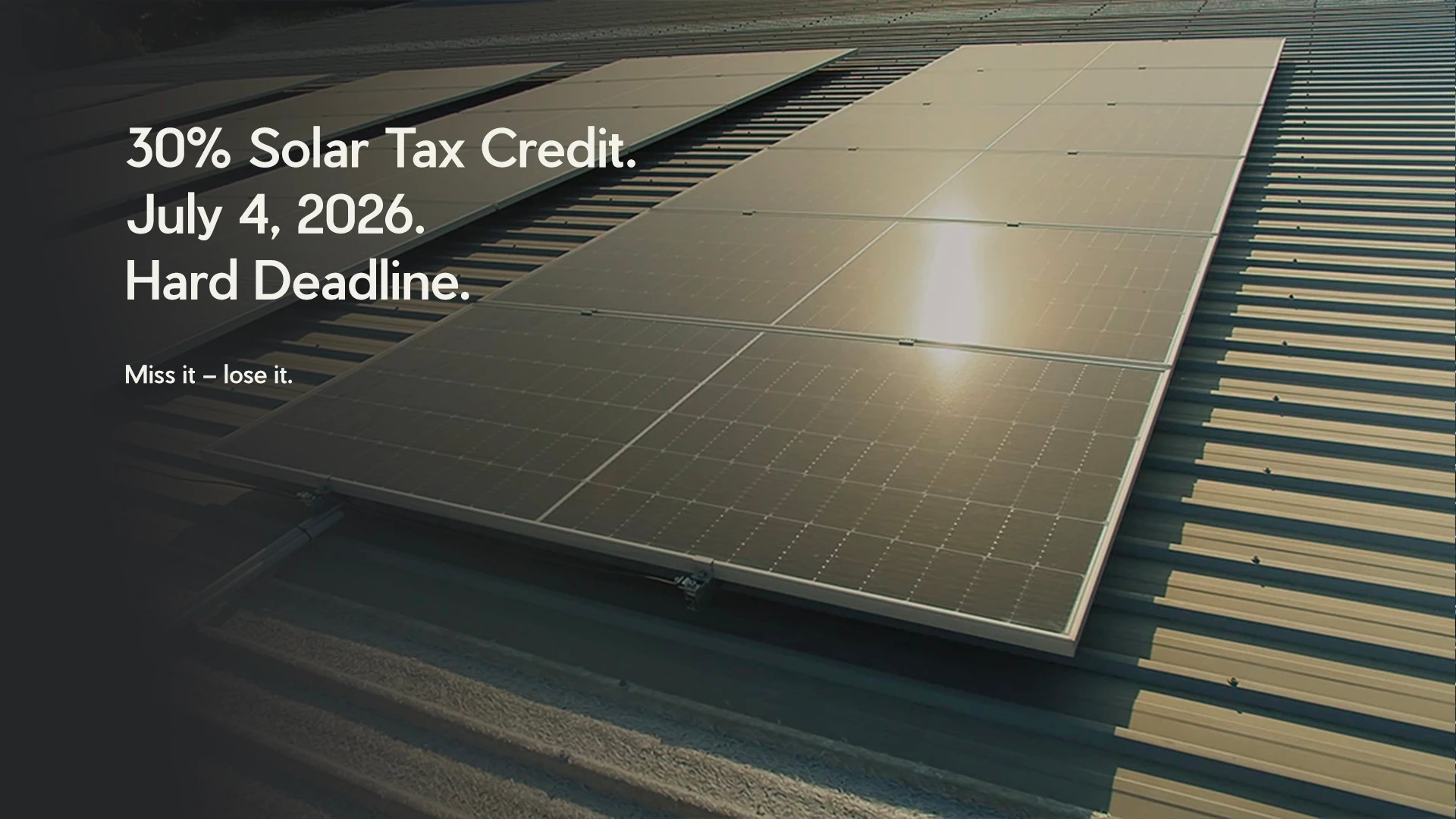
Your CFO just flagged something. July 4, 2026 is not just a holiday this year. It is the hard deadline for commercial solar projects to begin construction and still qualify for the full 30% federal Investment Tax Credit.
If your business has been weighing solar, the math just got simpler. Projects that begin construction by July 4 lock in the full ITC and get up to four years to finish.
The good news: "begin construction" does not mean breaking ground next week. A straightforward method called 5% safe harbor lets you secure the full credit with an equipment deposit. No physical work required. But the window to plan, contract, and execute is tightening fast.
Key Takeaways
- The 30% commercial solar ITC requires beginning construction by July 4, 2026 under the One Big Beautiful Bill (signed July 4, 2025)
- Projects that meet the deadline get until December 31, 2030 to complete installation
- The 5% safe harbor method is the fastest path: pay or incur 5% of total project costs on equipment before the deadline
- Bonus adders can push the credit to 40-50% (+10% domestic content, +10% energy community)
- New FEOC rules restrict equipment sourcing from certain countries starting in 2026
- Battery storage projects remain eligible under the original IRA timeline with less compressed deadlines
- Documentation is critical. IRS audits of safe harbor claims are common
1. What Changed and Why the Deadline Matters Now
The One Big Beautiful Bill rewrote the timeline for commercial clean energy tax credits. Under the original Inflation Reduction Act, the 30% ITC was available through at least 2032. That runway has been cut dramatically.
Commercial solar projects that begin construction on or before July 4, 2026 qualify for the full 30% credit with until December 31, 2030 to finish. Projects that start after July 4 but are placed in service by December 31, 2027 can still qualify, but that is an extremely tight window for design, permitting, procurement, and installation. Miss both milestones and the credit is gone.
For a $500,000 installation, the 30% ITC is $150,000 in direct tax liability reduction. With bonus adders, that number reaches $200,000 to $250,000. Walking away from that because of a missed deadline is an expensive oversight.
Consult your tax advisor. Based on current IRS guidance under Sections 48/48E.
2. The 5% Safe Harbor Method
For projects at 1.5 MW AC or smaller (which covers the vast majority of commercial rooftop and on-site installations), the simplest way to begin construction is 5% safe harbor.
Pay or incur at least 5% of total eligible project costs before July 4, 2026. This typically means placing a non-refundable deposit on project-specific equipment: panels, inverters, or racking. No on-site construction required. No permits need to be filed. The IRS recognizes this financial commitment as starting your project.
Once safe harbored, you have until December 31, 2030 to complete installation. That multi-year runway lets you finalize design, work through permitting, coordinate with your operations, and install when it makes sense for your business.
At Greenway, we handle commercial projects from feasibility through interconnection. Our team structures the equipment purchases, builds the timeline, and documents everything the IRS requires. Documentation is not optional. It is what separates a valid claim from one that gets challenged in audit.
3. The Physical Work Test Alternative
For larger projects above 1.5 MW AC, or for businesses that prefer demonstrating progress through construction activity, the Physical Work Test is the alternative.
This requires starting significant physical work of a continuous nature by the deadline: breaking ground, pouring foundations, installing racking, or beginning off-site fabrication of custom components. The keyword is "continuous." Starting and then pausing without justification can jeopardize the claim.
Most Greenway commercial projects qualify for the simpler 5% safe harbor route. If yours involves a larger multi-megawatt installation or solar garden, we can determine which method fits and what documentation applies.
4. Bonus Adders That Push the Credit to 40-50%
The base 30% is significant. Bonus adders make it exceptional.
The Domestic Content Bonus adds 10% for projects meeting American-made sourcing thresholds. With new FEOC restrictions limiting equipment from countries like China, Russia, and North Korea, domestic sourcing is becoming both a compliance requirement and a financial advantage.
The Energy Community Bonus adds 10% for projects in areas tied to fossil fuel employment or retired coal facilities. Parts of Minnesota and the broader Midwest qualify.
Full base rate eligibility on larger systems requires Prevailing Wage and Apprenticeship compliance. Greenway's status as a licensed electrical contractor with a registered apprenticeship program positions our projects well here.
Consult your tax advisor. Based on current IRS guidance under Sections 48/48E.
5. What the Credit Means for Long-Term ROI
The ITC reduces upfront cost, but ongoing savings are where the real return lives. This is where the tax credit connects to the daily financial case for commercial solar.
Electricity rates are climbing. Xcel Energy has proposed rate increases for Minnesota customers, and national commercial rates rose roughly 5% year-over-year. Solar locks in a predictable energy cost for decades. Pair that with demand charge reduction through battery storage and the financial case compounds further. When your business uses battery storage to shave peak demand during expensive hours and solar to offset daytime consumption, both your energy charges and demand charges drop.
Greenway's commercial clients, including Fulton Brewing, Hennepin Made, and SunOpta, invested in solar for this reason. The ITC made the upfront economics work. The ongoing savings from reduced grid dependence and predictable costs deliver value long after the credit is claimed. Typical payback with the full ITC runs 5 to 7 years, with continued savings for 30+ years.
6. What to Do Between Now and July 4
Five months sounds like time, but commercial projects involve multiple decision points.
Start with a feasibility conversation. Greenway's NABCEP-certified team can assess your site, model production, and estimate costs within weeks. From there, system design and equipment selection is where the 5% deposit gets structured. The deposit itself can happen quickly once you have a design and signed contract.
You do not need to install anything before July 4. You need to commit to the right equipment and document it properly. Greenway handles everything end to end: feasibility, design, permitting, installation, interconnection, and incentive management. We partner closely with architects, GCs, and engineers, using only direct employees.
FAQs
Can I claim the ITC on battery storage without solar?
Yes. Standalone battery storage remains eligible for the 30% ITC under the original IRA timeline with less compressed deadlines. If your business needs backup power or demand charge reduction through storage, this incentive path is still available.
What if my project uses equipment from China?
FEOC rules effective in 2026 restrict credit eligibility for projects using equipment from certain countries. Projects safe harbored before December 31, 2025 are generally protected. Projects safe harboring in 2026 must comply with FEOC sourcing requirements.
How does Greenway help with the safe harbor process?
We manage the full scope: site assessment, system design, equipment procurement, safe harbor documentation, permitting, installation, and interconnection. Our NABCEP-certified team has managed ITC-eligible commercial projects for over a decade, including work with Fulton Brewing, North Market, Hennepin Made, and SunOpta.
What ongoing savings should I expect after the tax credit?
Beyond the ITC, commercial solar reduces your energy charges through on-site generation and can significantly cut demand charges when paired with battery storage. Time-of-use rate optimization adds another layer of savings. Many of our clients see total energy cost reductions of 30% or more over the life of the system.
If you have been considering solar for your business and the ITC timeline has pushed it to the front of the conversation, we can help you understand what the credit looks like for your specific building and energy profile. Reach out at Info@GreenwaySolar.org or call us to start with a feasibility conversation.
Fill out our client inquiry form today, so we can reach out and help you start taking advantage of the many benefits of solar!
Here at Greenway, we believe in solar for all. For homeowners, we install standard solar panels, EV chargers, battery storage, and the SPAN panel. We are also a certified installer of the Tesla Solar Roof and Powerwall. If you don’t own a home but want the benefits of solar, then subscribing to one of our three community solar gardens might be right for you.
Certified to Install:


More to Read
More posts are coming soon! Sign up using the form below to be notified.

Your Electric Bill Went Up and You Didn't Use More Power. Here Is Why.

Here's How Commercial Solar Systems Are Actually Sized in Minnesota
The Difference Between a Solar Installer and a Solar Partner
Get Greenway Updates in Your Inbox.
Enter your email to receive notifications of new posts.