

How Demand Charges Are Silently Driving Up Your Business Energy Bill

You review your electricity bill every month. You check the kilowatt-hour charges, compare them to last month, and figure things are roughly in line. But there's often a second set of charges sitting on that same bill, calculated in a way that has nothing to do with how much energy you used over the month.
For many Minnesota commercial and industrial operations, especially heavy industrial users, demand charges aren't just a line item. They're the largest portion of the entire bill. And because the calculation is based on a single 15-minute window, one equipment startup event on a Monday morning can set your cost ceiling for the next 30 days.
Understanding what demand charges are and what options exist to address them is one of the most practical conversations a Minnesota business owner can have about energy.
Key Takeaways
- Demand charges are based on your highest 15-minute consumption window in a billing period, not total monthly usage
- A single equipment startup can set your demand charge for the entire month
- Battery storage reduces demand charges by discharging during peak windows before the meter records them
- Solar generation during business hours can lower peak demand when production and usage align
- Solar plus storage provides the deepest, most consistent demand charge reduction
- These savings compound over time, adding long-term value beyond basic energy offset
- No changes to daily operations are required with a well-designed system
1. What Demand Charges Actually Are
Residential customers pay for the energy they use, measured in kilowatt-hours (kWh). Commercial and industrial customers typically pay for something additional: the peak rate at which they drew power during any 15-minute interval in the billing period.
That peak draw is measured in kilowatts (kW) and becomes your demand reading for the month. Your utility applies a charge based on that reading, regardless of how the other 29 days looked.
For businesses running manufacturing lines, HVAC systems, refrigeration banks, or any combination of high-draw equipment that starts at similar times, the 15-minute peak can spike well above average. That spike sets the demand baseline for the month, and there's no correcting it after the fact.
Reducing the height of that peak, even modestly and consistently, can result in real changes to your monthly bill over time.
2. Four Ways Solar and Storage Address the Problem
The right approach depends on when your peak demand occurs, how consistent it is, and your utility rate structure. Here are the four scenarios we work through with commercial clients:
Scenario 1: Grid-Only. No buffer, no offset. Your facility's peak demand registers fully on the meter every month.
Scenario 2: Storage Only. The battery charges during off-peak hours and discharges during your facility's high-demand window, reducing the peak the meter records. No changes to operations required.
Scenario 3: Solar Only. On-site generation reduces your overall grid draw during daylight hours. When production aligns with your peak usage window, it naturally brings the demand reading down. This works well for facilities with heavy daytime loads, though alignment isn't always consistent.
Scenario 4: Solar Plus Storage. Solar offsets daytime consumption and charges the battery with excess production. The battery discharges during the peak window. The result is a reduction in both overall energy usage and peak demand, consistently, over the full life of the system.
3. Why the Savings Build Over Time
A demand charge reduction isn't a one-time event. Every billing cycle where your system shaves the peak is a billing cycle where that saving shows up on your statement. Over five, ten, fifteen years, that compounds independently of, and in addition to, the energy savings from solar generation.
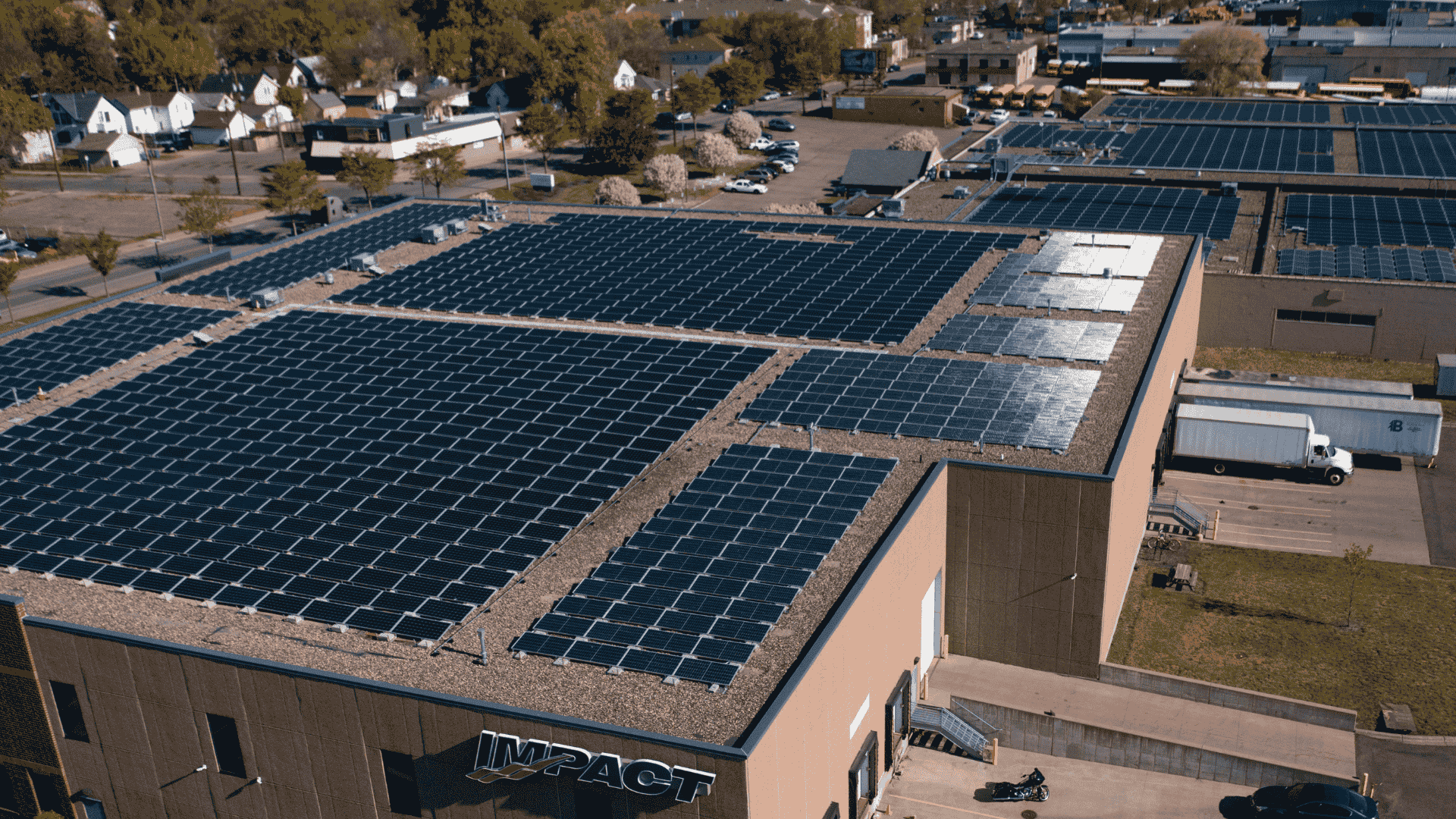
This is why demand charge reduction is often a central part of the commercial solar ROI picture, not just a side benefit. For facilities like breweries, manufacturers, or commercial kitchens running heavy equipment on predictable schedules, this kind of long-term savings structure can be meaningful. We've designed systems for Fulton Brewing, Hennepin Made, and SunOpta with exactly this in mind.
And if you're approaching the ITC deadline at the same time, the combination of a lower upfront cost through the credit and ongoing demand charge reduction can make the payback timeline for a commercial project as short as 5 to 7 years. You can read more about how the ITC factors into the commercial case in our related post on the ITC deadline and commercial solar ROI.
Consult your tax advisor. Based on current IRS guidance under Sections 48/48E.
4. When Solar Alone Is Enough and When It Isn't
Solar without storage is a strong play for reducing your overall energy costs — your monthly kWh consumption goes down, and that shows up on your bill. But for demand charge reduction specifically, solar alone is unreliable.
Here's why: demand charges are set by a single 15-minute peak. Solar output isn't dispatchable — it depends on weather, cloud cover, and time of day. Even if your heaviest loads typically run mid-morning through mid-afternoon, one overcast Monday where equipment starts up without solar offset sets your demand reading for the entire month. Solar didn't fail for the month. It just wasn't available for that one window.
So while solar may incidentally lower your demand reading in months where production and peaks happen to align, that's not a designed outcome you can count on or build an ROI case around.
Storage changes this because it's dispatchable. You can direct it to discharge during your peak window regardless of what the sun is doing. That's the meaningful difference.
Here's when storage becomes necessary for demand charge reduction:
- Your facility's peak demand occurs in the early morning or evening, outside solar hours
- Your peak demand is inconsistent across days, meaning solar coverage during your highest spikes is unpredictable
- You want reliable, consistent demand charge savings rather than incidental ones
- You want backup coverage in addition to demand charge reduction
If your goal is purely energy cost reduction and demand charges are a small portion of your bill, solar alone may be sufficient. But if demand charges are a significant line item — and for most commercial and industrial operations in Minnesota they are — storage is what makes the reduction reliable.
Understanding your load profile, specifically when your 15-minute peaks actually occur, is the starting point for any design conversation.
5. How to Read Your Utility Bill for Demand Charges
Here's what to look for:
- Look for a line item labeled "demand charge," "capacity charge," or similar
- The charge is usually expressed as a rate multiplied by your peak kW reading for the month
- Your kW peak is listed separately from your kWh total
- Some utilities use a "ratchet clause," which can hold your demand charge to a minimum percentage of your highest reading over the past year, even if your current month's peak was lower
If you're not sure what you're looking at, send your recent utility bills to us and we can help you understand the structure before any design conversation begins.
6. Making the Business Case Internally
For many facilities managers and operations leaders, the challenge isn't understanding why demand charge reduction matters. It's explaining it clearly to ownership, finance, or a board that hasn't been part of the conversation.
A few framing points that tend to land well:
- Demand charges are often 30-50% of a commercial utility bill for heavy users. That's a recurring cost center, not a fixed one.
- Storage-only peak shaving requires no changes to operations. Staff routines, equipment schedules, and production remain unchanged.
- The payback case for commercial solar with ITC in place is well-documented. Savings from demand charge reduction add to that case, not replace it.
- Solar and storage assets also contribute to property value, ESG reporting, and tenant appeal, outcomes that have organizational value beyond the utility bill.
For a closer look at how we approach commercial solar design, visit our commercial solar page or browse our completed commercial projects.
FAQs
How do I know if demand charges are a significant part of my bill?
Look for a "demand charge" or "capacity charge" line item on your utility statement, or request your rate schedule from the utility directly. If you'd like a second set of eyes on your bill, we're happy to review it.
Will solar automatically reduce my demand charges?
Not always. If your peak demand occurs outside daylight hours, solar alone won't address it. Storage fills that gap by discharging at any time based on your usage pattern.
Does a peak shaving system require changes to how we operate?
No. A well-designed system runs automatically based on your usage data and rate schedule. Your equipment and staff routines stay exactly as they are.
How does the ITC deadline apply to commercial battery storage?
Storage paired with solar on commercial projects can be eligible for the ITC. Acting before July 4, 2026 preserves today's credit rates. Consult Greenway Solar for how storage fits into your specific incentive picture.
What is a ratchet clause and does it affect how useful demand charge reduction is?
A ratchet clause holds your demand charge to a minimum percentage of your highest reading over a trailing period, typically 12 months. If your utility uses one, it means demand charge reduction through storage takes longer to fully show up on your bill, but the benefit still accumulates once the ratchet baseline adjusts over time.
If you'd like to understand what demand charges are costing your operation and whether solar or storage makes sense for your facility, we're happy to take a look. Reach out at Info@GreenwaySolar.org, call (612) 416-1518, or request a consultation here.
Fill out our client inquiry form today, so we can reach out and help you start taking advantage of the many benefits of solar!
Here at Greenway, we believe in solar for all. For homeowners, we install standard solar panels, EV chargers, battery storage, and the SPAN panel. We are also a certified installer of the Tesla Solar Roof and Powerwall. If you don’t own a home but want the benefits of solar, then subscribing to one of our three community solar gardens might be right for you.
Certified to Install:


More to Read
More posts are coming soon! Sign up using the form below to be notified.

Your Electric Bill Went Up and You Didn't Use More Power. Here Is Why.

Here's How Commercial Solar Systems Are Actually Sized in Minnesota
The Difference Between a Solar Installer and a Solar Partner
Get Greenway Updates in Your Inbox.
Enter your email to receive notifications of new posts.