

The Real Numbers Behind a Solar-Powered Life

Solar companies love projections. Estimated savings. Modeled production. Forecasted payback. Those numbers matter when you are making a decision, but they are still estimates.
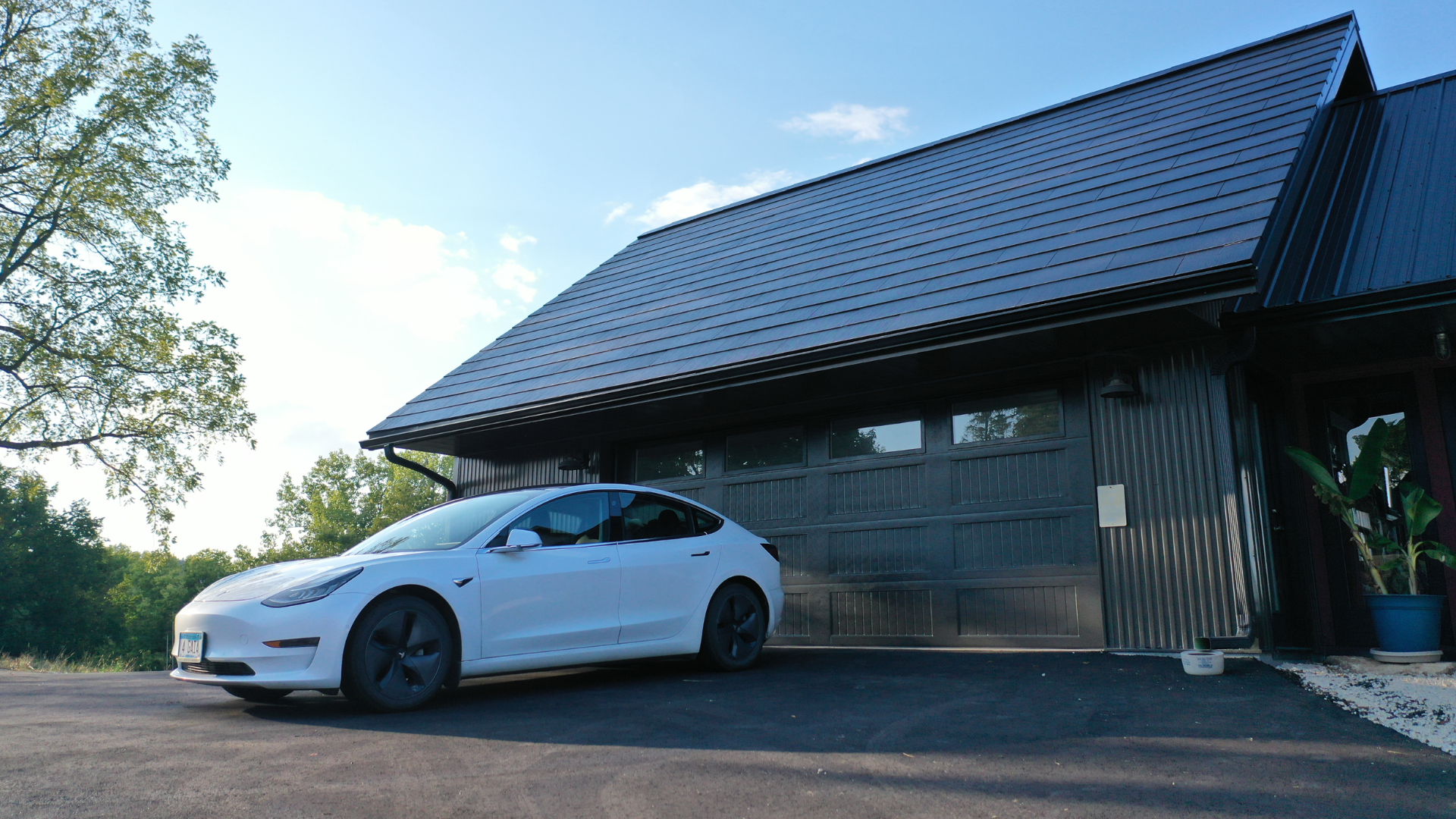
What if you could see the actual numbers from a real solar-powered home, tracked month by month over three full years? That is exactly what Joe Deden and Mary Bell have documented at their all-electric home in Lanesboro, Minnesota, designed with Shawn Saltou of Midwest Design and built by Greenway Solar. Every kilowatt-hour generated, consumed, exported, and imported is recorded. The system went live in February 2023, so the first year captures roughly 10.5 months of production. 2024 and 2025 reflect full calendar years. Here is what the data shows.
Key Takeaways
- The 32 kW Tesla Solar Roof has generated 42,000-46,000 kWh every year for three consecutive years.
- Total home usage (including EV charging) runs 23,000-28,000 kWh per year.
- The home exports roughly 29,000-30,000 kWh to the grid annually and imports 9,000-12,000 kWh.
- Net grid contribution averages around 17,000-19,000 kWh per year in the home's favor.
- Peak production months (May-July) average nearly 5,000 kWh per month.
- The system is in the top 1% nationally for both solar roof generation and grid export.
1. Three Years of Real-World Performance
Data tracking began in February 2023 when the system went live. The first year captures approximately 10.5 months of production. 2024 and 2025 reflect full calendar years.
- Solar production averaged: 44,464 kWh/annually
- Total household usage (home + EV charging): ~26,705 kWh/annually
- Home (excluding EV): 20,520 kWh/annually
- Tesla Model 3 charging: 5,184 kWh (enough for ~20,000 miles at typical efficiency, on a car with 155,000+ total miles)
- Result: 100% of electricity needs covered by solar, plus a large net export (18,228 kWh/annual equivalent after accounting for seasonal imports/exports)
- Grid export total: 28,797 kWh/annually (mostly in peak summer months)
2. Generation Year Over Year
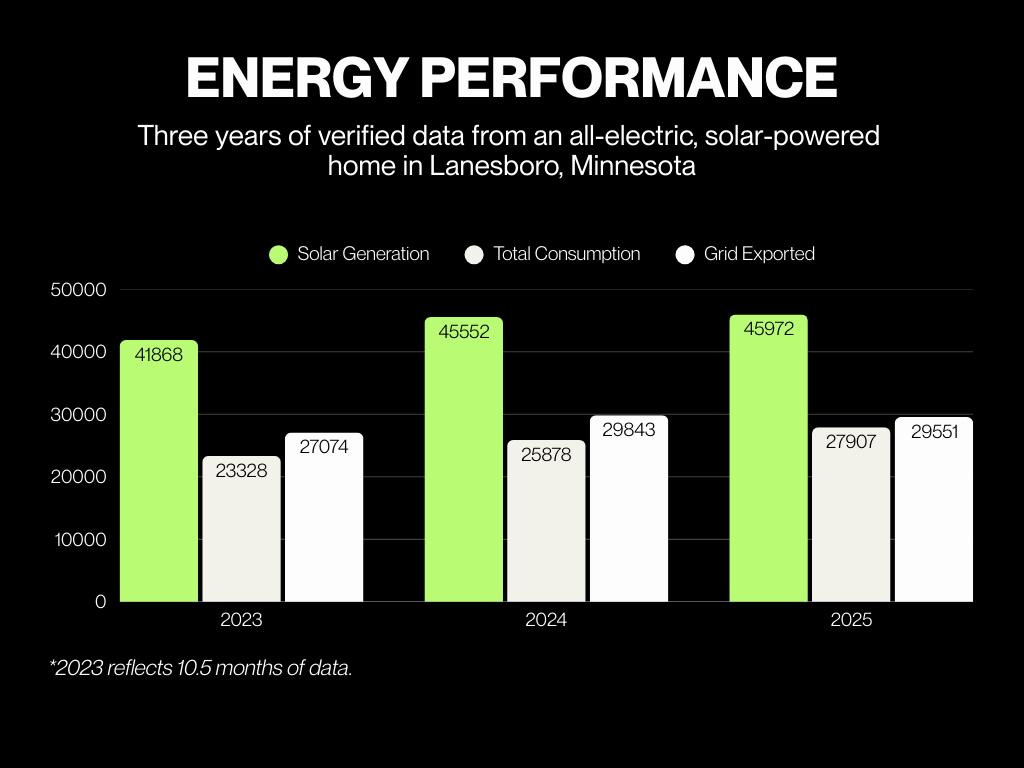
Consistency is the first thing that stands out. Despite Minnesota's variable weather, annual generation has been remarkably stable.
- 2023 (10.5 months): 41,868 kWh
- 2024: 45,552 kWh
- 2025: 45,972 kWh
The monthly pattern is predictable. January and December are the lowest production months, averaging 1,500-2,100 kWh. May through August are the strongest, regularly hitting 4,500-5,000 kWh. The 10/12 roof pitch (40 degrees) was chosen specifically to shed snow and capture low-angle winter sun, and the data shows it working.
.png)
3. Usage Tells Its Own Story
Home usage has crept up slightly over three years, from about 23,300 kWh in 2023 to 27,900 kWh in 2025. Some of that is the natural settling-in of a new home. Some reflects added electric tools and equipment.
Strip out EV charging (roughly 5,000-6,000 kWh per year) and home-only usage averages about 20,000-22,000 kWh annually. The largest consumers are the heat pump system (heating and cooling), the water heater (third-largest draw), and general household loads.
The SPAN smart panel makes all of this visible in real time. Joe and Mary can see exactly which circuits are drawing power and adjust behavior accordingly.
.png)
4. The Grid Relationship
This home is grid-tied, not off-grid, and that is an important distinction. The grid serves as a battery of sorts. During high-production months, the home pushes surplus energy out. During low-production winter months, it pulls energy in.
Over three years, the home has exported roughly 86,000 kWh to the grid and imported about 31,000 kWh. That is a net positive contribution of approximately 55,000 kWh. The home is not just self-sufficient. It is a net energy producer for the community.
5. EV Charging on Sunshine
The 2018 Tesla Model 3 has logged over 155,000 miles. The home's Level 2 charger provides roughly 83% of the car's energy. At an average of about 5,000 kWh per year for charging, the car adds meaningfully to total consumption but the solar system absorbs it without breaking a sweat.
The practical takeaway is that solar can realistically fuel your daily driving if the system is sized correctly.
6. What Three Years Proves
Short-term data is encouraging. Three-year data is proof. The system performs as designed. Production is consistent. The technology is reliable. The home is comfortable. And the economics work, generating approximately $4,200-$4,500 per year in net metering income while eliminating fossil fuel costs entirely.
This is not a prototype. It is a blueprint.
FAQs
Has production degraded over three years?
No. Generation has actually been slightly higher in years two and three compared to the initial partial year. Solar panels degrade slowly over time (typically 0.25-0.5% per year), but three years is too early to see meaningful degradation.
Why does usage keep increasing?
The homeowners have added equipment and adjusted habits over time. This is normal for any home. The important point is that the solar system still produces far more than the home needs even with growing consumption.
Is this data publicly available?
Joe and Mary have shared their data through the ASES National Solar Tour, Solar Today magazine, and educational presentations. The Elmwood Electric Report tracks every metric monthly.
Could a smaller system achieve similar results?
A smaller home or a home with lower energy needs could achieve net-zero or net-positive with a smaller array. The key is matching system size to actual usage patterns and site conditions.
Want to See What Your Numbers Could Look Like?
Greenway Solar can model your home's solar potential using your actual utility data, roof characteristics, and energy goals. No estimates pulled from thin air, just real analysis. Start your solar review.
Fill out our client inquiry form today, so we can reach out and help you start taking advantage of the many benefits of solar!
Here at Greenway, we believe in solar for all. For homeowners, we install standard solar panels, EV chargers, battery storage, and the SPAN panel. We are also a certified installer of the Tesla Solar Roof and Powerwall. If you don’t own a home but want the benefits of solar, then subscribing to one of our three community solar gardens might be right for you.
Certified to Install:


More to Read
More posts are coming soon! Sign up using the form below to be notified.

Your Electric Bill Went Up and You Didn't Use More Power. Here Is Why.

Here's How Commercial Solar Systems Are Actually Sized in Minnesota
The Difference Between a Solar Installer and a Solar Partner
Get Greenway Updates in Your Inbox.
Enter your email to receive notifications of new posts.