

Rising Electricity Rates Are Changing the Math on Commercial Solar

You've probably noticed your electricity bills going up. You're not imagining it.
Utility rates have been climbing steadily, and for businesses paying commercial electricity prices, those increases add up fast. What's interesting is how this shifts the conversation around solar. Not just whether it makes sense, but how quickly it pays for itself.
A recent Wood Mackenzie analysis put some numbers to what we've been seeing with our commercial clients. The findings are worth understanding if solar has been somewhere on your radar.
Key Takeaways
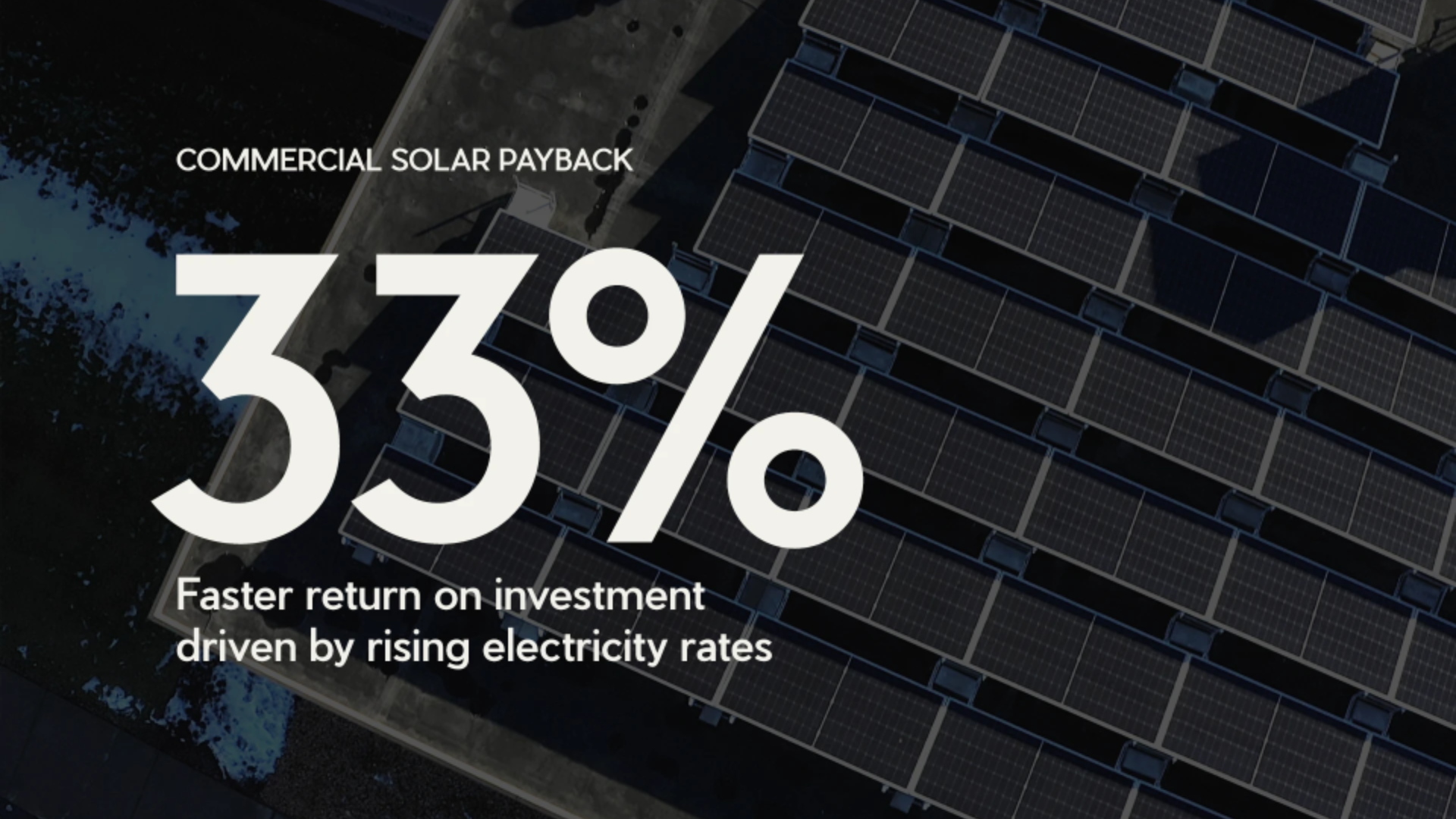
- Rising electricity rates are shortening commercial solar payback periods significantly. In some scenarios, by as much as 33%.
- The national average payback for a commercial solar project drops from around 6.3 years to 4.2 years when factoring in higher rate growth projections.
- Commercial solar installations hit a record 2,118 MW in 2024 and continued growing through 2025 even as system prices increased.
- High-rate states like California, Hawaii, New York, Massachusetts, and Connecticut see the fastest paybacks. But the economics are improving across a broader range of markets.
- As federal tax incentives begin phasing down, the gap between solar costs and grid power costs becomes the primary driver of project viability.
What the Numbers Actually Show
Wood Mackenzie looked at what happens to commercial solar payback periods under different electricity rate scenarios. The baseline assumption most people use is around 2% annual rate growth. That's been the historical average.
But rates haven't been growing at 2% lately. When you model 6% annual growth, which is closer to what many markets are experiencing, the payback math changes substantially.
At 2% rate growth: average payback of 6.3 years.
At 6% rate growth: average payback of 4.2 years.
That's a 33% reduction in the time it takes to recoup your investment. For a business evaluating capital projects, that's a meaningful difference.
Why This Is Happening Now
A few things are driving electricity prices up.
Grid infrastructure is aging and utilities are spending heavily on upgrades. Those costs get passed through to ratepayers. Data centers and electrification are increasing demand on the grid, which pushes prices higher in constrained markets. Fuel costs and supply chain factors continue to create volatility.
For businesses, this means the cost of doing nothing keeps going up. Every year you wait, you're paying more for grid power that could be offset by generation on your own roof.
Where the Economics Are Strongest
Not every market is the same. The Wood Mackenzie analysis found a 12-year spread between the best and worst states for commercial solar payback.
The strongest markets include California, Hawaii, New York, Massachusetts, and Connecticut. They share a common factor: high commercial electricity prices. When you're paying more per kWh, the value of generating your own power is higher.
Minnesota sits somewhere in the middle nationally. Our rates aren't as high as the coasts, but they're not the lowest either. And they've been trending upward. For many of our commercial clients, the payback periods we're seeing today are noticeably better than they were even two or three years ago.
The Tax Credit Factor
The federal Investment Tax Credit is still available for commercial solar. The base credit is 30%, with bonus adders that can push it to 40% or 50% for qualifying projects. But the rules changed last year, and the timeline to capture those credits is tightening.
What's notable in the Wood Mackenzie analysis is that even as federal incentives decline, the economics still work in many markets. The widening gap between solar costs and grid power costs maintains project viability.
That said, the tax credits make a real difference in payback periods. A project that qualifies for the full 40 to 50% credit will see significantly faster returns than one that misses the deadlines.
If you're evaluating commercial solar, understanding both the rate environment and the incentive timeline matters.
What This Means for Minnesota Businesses
We're seeing this play out with our commercial clients. Businesses that were on the fence a few years ago are finding the numbers work better now than they expected. Rising rates are doing part of the work that incentives used to do alone.
The combination of higher electricity costs, available tax credits, and proven technology is creating a window that's worth evaluating seriously.
Solar still requires upfront investment and planning. Commercial projects take 6 to 12 months from first conversation to operational system. But for businesses with reasonable roof space and decent energy usage, the financial case keeps getting stronger.
Questions Worth Asking
If commercial solar has been on your list, here are a few things worth thinking through.
What's your current electricity rate, and how has it changed over the past few years? What's your annual energy usage, and how much of that could realistically be offset by rooftop solar? Does your building qualify for any of the ITC bonus adders like domestic content or energy community? What's your timeline for making a decision relative to the July 2026 construction deadline?
We're happy to walk through the specifics for your situation. Fill out our client inquiry form or give us a call.
Disclaimer: Actual energy savings and tax benefits vary based on individual situations. Consult a tax professional for guidance specific to your business.
Fill out our client inquiry form today, so we can reach out and help you start taking advantage of the many benefits of solar!
Here at Greenway, we believe in solar for all. For homeowners, we install standard solar panels, EV chargers, battery storage, and the SPAN panel. We are also a certified installer of the Tesla Solar Roof and Powerwall. If you don’t own a home but want the benefits of solar, then subscribing to one of our three community solar gardens might be right for you.
Certified to Install:


More to Read
More posts are coming soon! Sign up using the form below to be notified.

Your Electric Bill Went Up and You Didn't Use More Power. Here Is Why.

Here's How Commercial Solar Systems Are Actually Sized in Minnesota
The Difference Between a Solar Installer and a Solar Partner
Get Greenway Updates in Your Inbox.
Enter your email to receive notifications of new posts.