

How Commercial EV Charging and Solar Work Together to Future-Proof a Minnesota Business

A growing number of Minnesota businesses are installing EV chargers for employees, tenants, or fleet vehicles. The decision usually starts with a simple question: how do we add charging stations to our building?
The more important question is what happens to your electricity bill after you do.
EV chargers draw significant power. When multiple vehicles charge simultaneously during business hours, the spike in demand can trigger charges that overshadow the cost of the electricity itself. Without a strategy to manage that load, adding chargers can increase operating costs in ways most business owners do not expect. Solar and battery storage change the equation entirely.

Key Takeaways
- Adding EV chargers without managing the new load can significantly increase demand charges on a commercial utility bill
- Solar generation during business hours directly offsets daytime EV charging load
- Battery storage absorbs excess solar and discharges during demand peaks, preventing the spikes that set demand charges
- Integrated solar, storage, and smart load management can multiply effective charging capacity without costly electrical upgrades
- Two federal incentive deadlines apply: the commercial solar ITC (July 4, 2026) and the EV charger infrastructure credit (June 30, 2026)
- Greenway delivers the full system as a single-source provider: solar, Powerwall 3, Tesla Universal Wall Connector, and SPAN Smart Panel
The Demand Charge Trap
Commercial utility rates include two charges: energy charges based on total kWh consumed, and demand charges based on the highest power draw during any 15-minute window in the billing period. One busy morning where ten employees plug in at 8 AM can set a demand peak that determines your cost ceiling for the entire month.
The financial impact can be significant. Industry modeling by Paired Power showed that for a large workplace installation, demand charges from unmanaged EV charging made up the majority of the total electricity cost. Not the energy itself. The peaks.
For Minnesota businesses already dealing with how demand charges affect their energy bill, adding EV chargers without a load strategy compounds the problem.
How Solar and Storage Solve It
The solution is not to avoid EV chargers. It is to pair them with on-site generation and storage that manage the load intelligently. Each component plays a specific role:
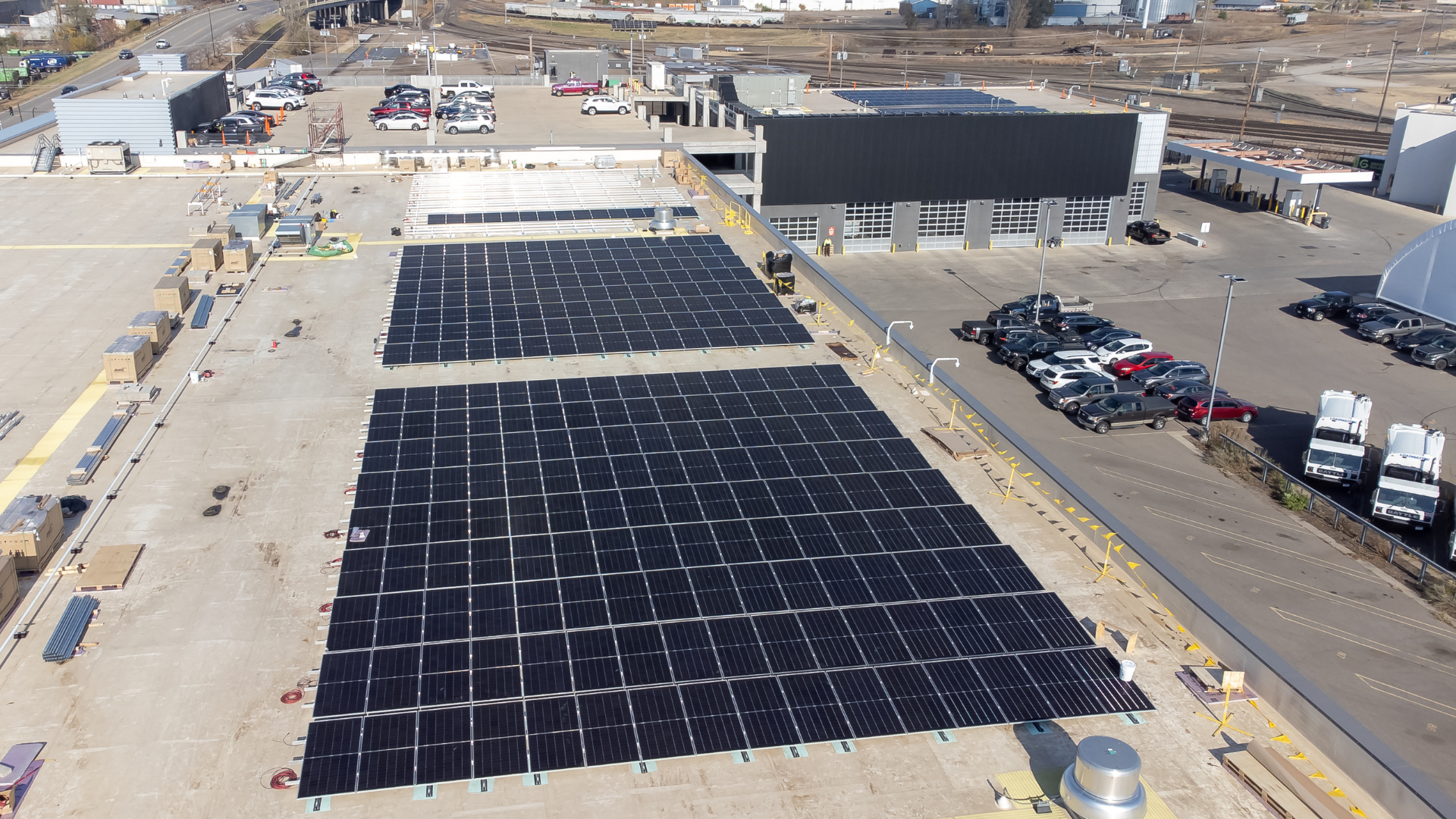
- Solar generation produces power during business hours, directly offsetting EV charging load. This reduces both energy charges and the contribution of EV charging to peak demand.
- Battery storage absorbs excess solar during midday and discharges during periods of high demand, preventing the sharp peaks that trigger demand charges. A properly sized system acts as a buffer between the grid and the chargers.
- SPAN Smart Panels provide circuit-level visibility and control, allowing the building to prioritize loads and distribute power across chargers, HVAC, lighting, and other systems in real time.
The results from integrated systems are striking. Paired Power found that combining solar, battery storage, and smart energy management at a 50-charger workplace cut annual utility costs by more than a third compared to running the same chargers without any load management. The integrated approach also multiplied effective charging capacity, allowing properties to serve significantly more vehicles using the same electrical infrastructure.
Why Planning Both Together Saves Money
A common mistake is installing EV chargers first and considering solar later. This creates two problems:
- Immediate cost exposure. Every month the chargers operate without solar and storage is a month the business absorbs the full cost of unmanaged peak demand.
- Retrofit complexity. Adding solar and storage around existing chargers is often more complex and expensive than designing the full system together from the start.
Utility infrastructure presents another risk. Many commercial buildings do not have enough available electrical capacity to support high-power EV charging. Upgrading transformers and service panels through the utility can take well over a year and cost six figures. Solar and storage can defer or eliminate those upgrades by generating and managing power on-site.
Greenway's commercial process handles this kind of integrated planning. From feasibility through interconnection, we design systems that account for current building loads, future EV charging demand, and the solar and storage infrastructure to support both. That is the same approach we bring to Minnesota businesses with complex energy needs.
Two Incentive Deadlines to Know
Two federal incentives apply to an integrated solar, storage, and EV charging project, and both have near-term deadlines.
- Investment Tax Credit (Section 48E). Delivers a 30% base credit on commercial solar and storage, with bonus adders for domestic content and energy community locations that can push the total higher. Projects must begin construction by July 4, 2026.
- Alternative Fuel Vehicle Refueling Property Credit (Section 30C). Provides a tax credit for qualified commercial EV charging infrastructure placed in service by June 30, 2026.
These are separate credits that can be claimed for different components of the same project, reducing the total investment in an integrated system. Consult your tax advisor for guidance specific to your project. Based on current IRS guidance under Sections 48/48E and 30C.
For businesses tracking the commercial ITC deadline, planning solar, storage, and EV charging as a single project maximizes credit value across all components.
Why Greenway for an Integrated System
Most businesses would need to coordinate separate contractors for solar, battery storage, EV chargers, and electrical panel upgrades. Greenway delivers all of it through one team:
- Solar. Tesla Solar Roof or premium panel systems designed for commercial rooftops, carports, and ground mounts
- Battery storage. Powerwall 3 with 11.5 kW continuous output and 13.5 kWh storage per unit, scalable to four units for commercial peak shaving
- EV charging. Tesla Universal Wall Connector installations
- Load management. SPAN Smart Panels for circuit-level monitoring and control across the facility
This single-source approach eliminates coordination gaps, reduces project timelines, and ensures every component works together from the start. Greenway's NABCEP-certified, direct-employee team handles the full project from feasibility through incentive management, with no subcontractors involved.
FAQs
Will adding EV chargers increase my demand charges?
Likely yes, unless the charging load is managed. Multiple vehicles charging simultaneously during business hours can create demand spikes that set your cost ceiling for the entire billing period. Solar and battery storage are the most effective tools for preventing this.
Can I add EV chargers and solar at the same time?
Yes, and we recommend it. Designing both systems together allows the solar and storage to be sized for the combined building and EV charging load, which optimizes performance and avoids the cost of retrofitting later.
Does the ITC apply to battery storage used alongside EV charging?
Yes. Under Section 48E, battery storage systems qualify for the commercial ITC. The storage system does not need to be exclusively for EV charging. Consult your tax advisor. Based on current IRS guidance under Sections 48/48E.
Does Greenway install EV chargers as well as solar?
Yes. We install Tesla Universal Wall Connectors, Powerwall 3 battery storage, and SPAN Smart Panels for commercial load management. This allows us to deliver the full integrated system through one team with no subcontractors.
If your business is planning to add EV charging, or already has chargers and wants to understand how solar and storage can reduce the cost of operating them, we would be glad to look at your situation. Reach out at Info@GreenwaySolar.org or call (612) 416-1518.
Fill out our client inquiry form today, so we can reach out and help you start taking advantage of the many benefits of solar!
Here at Greenway, we believe in solar for all. For homeowners, we install standard solar panels, EV chargers, battery storage, and the SPAN panel. We are also a certified installer of the Tesla Solar Roof and Powerwall. If you don’t own a home but want the benefits of solar, then subscribing to one of our three community solar gardens might be right for you.
Certified to Install:


More to Read
More posts are coming soon! Sign up using the form below to be notified.

Your Electric Bill Went Up and You Didn't Use More Power. Here Is Why.

Here's How Commercial Solar Systems Are Actually Sized in Minnesota
The Difference Between a Solar Installer and a Solar Partner
Get Greenway Updates in Your Inbox.
Enter your email to receive notifications of new posts.